F1 on TV!: Europe 2011
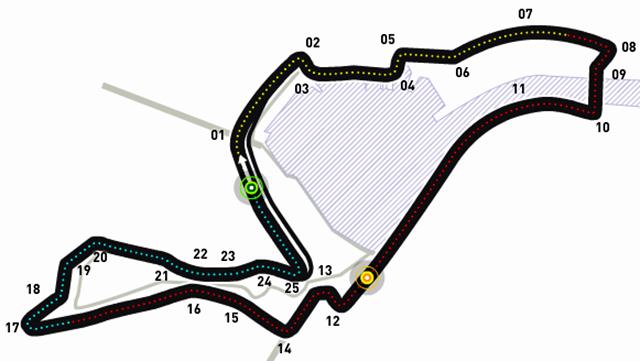
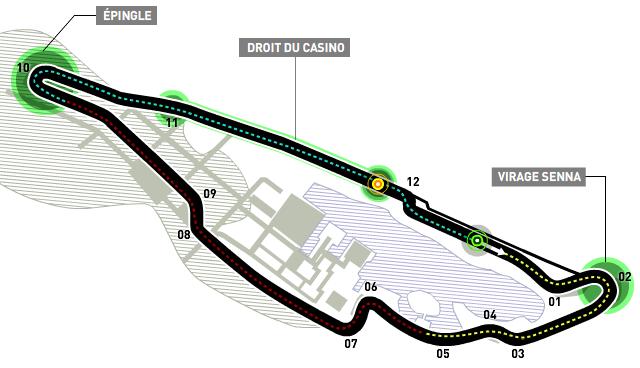
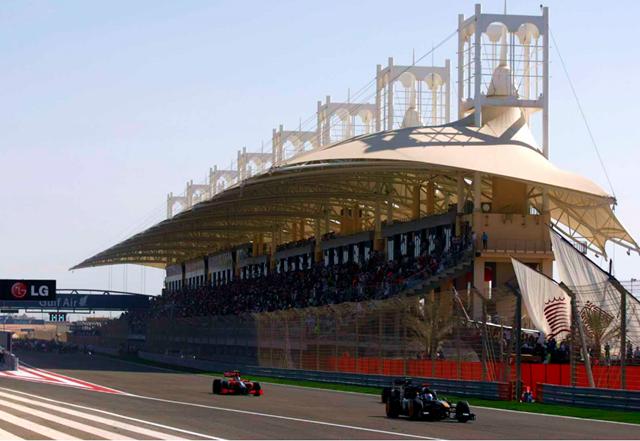
Their short North American sojourn completed, the F1 Circus returns to the Mother Continent this week with the 2011 Grand Prix of Europe. The European GP has always been a way to get a second race into whatever country has the popular driver at the time... which is why Germany had two races during the height of the Schumi Years. These days, it's HWMNBN... or at least, it was when the contracts were signed... which is why Spain now gets two races. To accomplish this feat, Spanish organizers built an all-new track in Valencia, a street circuit! And oh, did our hopes soar... only to be splatted to the ground like Icarus flying too close to the sun. A fly being nailed by a flyswatter. A X being Y'd by a Z (enter your own lousy analogy terms). Let's take a look at this hope-crushing circuit:
By all rights, a layout like that looks like this should be exciting... like Monaco, but with substantial high-speed sections. Unfortunately, it hasn't turned out that way. What we've discovered is that there's just too many turns in just the wrong places. For example, look at Turn 12: right at the end of the fastest part of the track, should be a great place to pass... except it's followed immediately by Turn 13, turning it into painfully slow chicane. Anybody passing on the inside of 12 winds up on the outside of 13, where they usually get scraped off by the car being passed... except nobody actually tries passing there, because they know what'll happen. And that's the problem all around the circuit: almost all the supposedly good passing points are actually soul-destroying chicanes!
At least, that's the way it used to be. As we've learned this season, the KERS/DRS combination makes even the dull circuits at least mildly interesting. Throw in the knowledge that Valencia is very wide for a street track and things are looking at least mildly hopeful again. Pirelli is thinking that tire wear will be high due to the combination of the number of turns (the most in F1), a rough track surface, and the predicted high air temperatures. They're bringing the Medium and Soft compounds this time around.
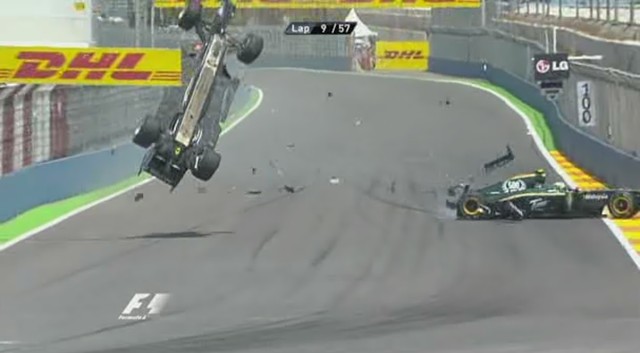
Of course, it's hard to forget the "highlight" of last year's race, and I'm not talking about Seb Vettel winning. I'm talking about his teammate's unexpected peregrinations.
Yup, this is the circuit where Red Bull Air first took flight. That was also the race that earned Kamui Kobayashi his nickname of "Gandalf." So it's not been without excitement, it just hasn't been really racing-related.
We'll be treated to the lovely dulcet tones of the Legendary Announce Team as usual. Alas, we'll be getting the race on tape-delay via FOX... but we'll get to that in a moment. Coverage begins with live streaming of Friday's 1st Practice from 3am to 430am. Practice 2 will be live on SPEED from 7am to 840am. Saturday's 3rd Practice will be streaming as well, from 4am to 5am. The all-important Quals session comes to us live on SPEED from 7am to 830am.
Finally, the race will be airing on your local FOX affiliate from 11am to 1pm, some five hours after it really begins. All times are Pond Central, of course.
F1U! will be all over the race weekend, like a Xis all over Z, with a side helping of µß. We'll see you then!
Posted by: Wonderduck at June 21, 2011 11:13 AM (OS+Cr)
3
This is somewhat off-topic, but while the Red Bull team is the darling of F1, the Red Bull NASCAR team will not be back next year. :-(
Posted by: Mallory at June 21, 2011 11:41 AM (WJ2qy)
4
So what are your thoughts on Lewis & Horner talking in Canada? Not to mention Lotus Renault on the future powerplant & Steve Nielsen quieting, is the silly season starting very early?
Posted by: von Krag at June 21, 2011 07:30 PM (VGXAE)
5
Well to start with, Hamilton is under contract with McLaren through the 2012 season, so nothing will happen until then. I'm sure Lewis and the Red Bull chief at least had preliminary discussions about him leaving McLaren, but that's all it was, probably: talk. Ham's been with McLaren since he was six, after all...
Renault is seriously on the short list of teams I don't like right now. First there's the whole "Lotus" thing, which I don't even want to get into right now. Now there's all this about the team demanding that the FIA move to the four-cylinder turbo engine in 2013, else they'll quit the sport. If everybody else wants to stay with the 8 cylinder, I say let Renault leave. To be blunt, they've threatened to do so before and haven't... I don't believe them. It's exactly like Ferrari threatening to leave: it'll never happen, because it means too much to them.
Steve Nielsen is leaving the team at the end of the year. Renault is... how shall we say?... restructuring their higher-ups; chief designer Bob Bell is gone too, shuffled out by the reorganization. Alan Permaine will be taking over Nielsen's duties as Sporting Director... he's no stranger to those of us who watch SPEED, as he's a good friend of Steve Matchett, one of the Legendary Announce Team, and one-time Renault race engineer. I suspect that we'll be seeing Flavio Briatore back sooner or later...
Posted by: Wonderduck at June 21, 2011 08:24 PM (n0k6M)
6
I'm in favor of setting a size limit then "run what you bring", but seeing this on the BBC F1 site gives new meaning to the word politics.
Formula 1 bosses have agreed to delay the introduction of new 'green' engines by a year until 2014. The move comes after opposition to the early switch to 1.6-litre turbo engines fitted with extensive hybrid technology from the current 2.4-litre V8s. As part of the compromise, the new engine formula will be for six-cylinder engines rather than the four-cylinder units that were originally agreed.
Ah well it wouldn't be F1 without someone acting like peeved child.
Posted by: von Krag at June 22, 2011 01:07 PM (VGXAE)
Saturday Night Tunage II
As the motivation to write anything in-depth and interesting seems to have departed my body as of right now, I've decided to do another Saturday Night Tunage post! Come, be amazed at my myriad musical tastes!
1
So, have any anime theme songs or sound tracks tickled your fancy?
Posted by: Siergen at June 18, 2011 11:40 PM (PvrXx)
2
Nothing recent, Siergen, other than Magia. The Angel Beats soundtracks are great fun, though. For example, three different versions of "Crow Song", all of them good in their own ways.
Posted by: Wonderduck at June 18, 2011 11:56 PM (n0k6M)
Posted by: bouff at June 19, 2011 09:55 PM (GhfbT)
9
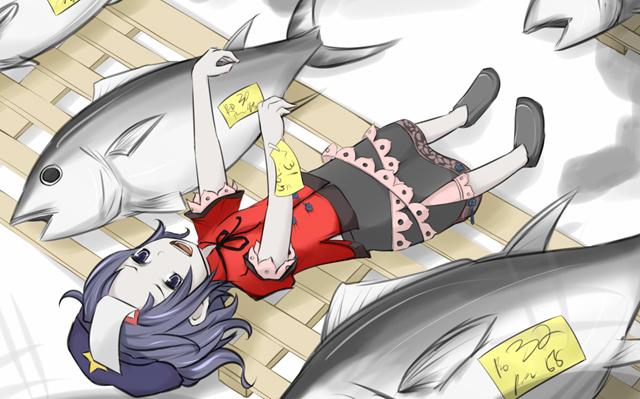
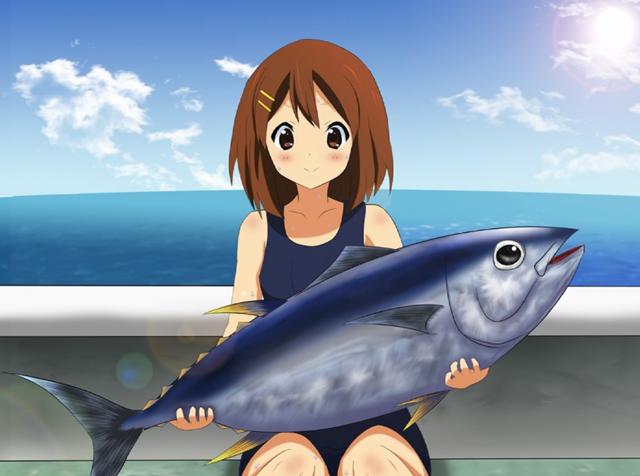
What I've found is that she's a minor character from the Touhou franchise named Miyako Yoshika. No less a person than TheBigN himself posted the original picture to Danbooru, so perhaps he can shed some light on the subject... let me see what I can do to summon hisownbadself...
Posted by: Wonderduck at June 19, 2011 10:19 PM (n0k6M)
So you just have to look at it the other way. It's not a dead girl amongst dead fish to be used as food, it's actually zombie fish and a zombie girl being sold as bodyguards.
I think the fish will require some frickin' laser beams on their frickin' heads to be any good at the job, though.
Posted by: Mikeski at June 20, 2011 01:53 PM (GbSQF)
12
On the comments for that picture on danbooru, one person actually notes that one of the Yoshika's nicknames as attributed by some fans is "Maguro-chan", which references bed habits apparently.
Posted by: TheBigN at June 20, 2011 02:46 PM (k33Ji)
13
What is it with Touhou and Chinese girls as ineffective security guards?
At any rate, thanks for the music - I was stuck at work on Saturday night and it helped a lot.
Posted by: Avatar_exADV at June 20, 2011 03:35 PM (pWQz4)
It's funny: I was, at best, indifferent to the Foos before that AMV. (Fully deserving of its win, I hasten to add.) Now I'm... slightly more than lukewarm to them. I picked up "Echoes Silence Really Long Album Title Guys" and like a few tracks off of there, but I'll probably never be a huge fan. I can respect 'em a lot more, though.
Posted by: GreyDuck at June 21, 2011 09:28 PM (7lMXI)
16
Okay, dead-ish. Mostly dead. Possibly pining for the fjords.
Posted by: Pixy Misa at June 21, 2011 11:37 PM (2yngH)
It's Time For A Show Of Hands
Okay, here's the gig. As many of you know, I devoted a good three months of my life to the horror that is Rio Rainbow Gate!. Tens of thousands of words, dozens of pictures, and many hours of agony were spent chronicling the so-called adventures of Rio Tachibana as she strove to become the Most Valuable Casino Dealer. After the suffering was over, I even revisited Episodes 02 and 03, which I didn't review the first time around, just to be complete.
At which point, I figured I was done with the whole show and I could let the healing process begin. But an unfortunate search of my archives for something completely unrelated to RRG! called my attention to an unsettling fact: in truth, my writeup for Episode 01 doesn't match the same theme or tone of the later ones. In fact, it's downright evil in its vituperation for the show. To be fair, I hadn't seen the whole series yet, hadn't truly embraced the stupid fun of its lack of seriousness, and hadn't yet had enough braincells killed off to appreciate it all.
So I come to you, my readers, with a question: do you want me to go back and do a full-fledged writeup of Rio Rainbow Gate! Episode 01, or are you tired of visiting Casino Island? Leave your decision in the comments, please.
My soul weeps, for I suspect I already know what the answer will be.
Posted by: ButMadNNW at June 16, 2011 07:20 PM (o8ylv)
3
I say do it - but only if you can somehow work into it some aspect of the World War II Pacific campaign.
Posted by: Siergen at June 16, 2011 08:08 PM (PvrXx)
4
If you can somehow include an animated GIF of the cut of Rio's bust jiggling as she walks, I don't care what you write.
Posted by: Ed Hering at June 16, 2011 08:41 PM (n4AaW)
5
So not only has RRG caused you to suffer some kind of mental damage, it's actively trying to spread, and manufacturing new opportunities to do so? We need to quarantine you, and then hit you with antibodies. I'll have to give some serious thought to what is the appropriate anibody for this affliction. Rainbow colored ponies, perhaps?
Posted by: David at June 16, 2011 10:34 PM (Kn54v)
6
No stopping this juggernaut, it seems. We should gird ourselves for the inevitable.
Posted by: Vaucanson's Duck at June 17, 2011 11:37 AM (XVJDy)
Seat Swap: Hamilton vs Stewart
Every now and again, something particularly cool will trickle out of the motorsport world. Some years ago, SPEED ran a TV show called "Tradin' Paint." The concept behind it was simple: take two racers from different series and put them in the other driver's car. In that one-hour event, they got what might have been the two most dissimilar drivers in the world, plunked 'em down on the Indianapolis Motor Speedway's International Circuit, and let 'em loose. The two drivers? From NASCAR, Jeff Gordon. And from Formula 1, Juan Pablo Montoya (aka "The Pope"). Neither driver did particularly well in the other car, it must be said: Gordon spun the 2002 Williams FW24, and Montoya never quite got the hang of the awful brakes on the Chevy; at one point, he flatspotted his tires so badly that the canvas backing was visible on the front-left corner. Still, both drivers loved the experience, Montoya so much that a few years later, he quit F1 and jumped to NASCAR.
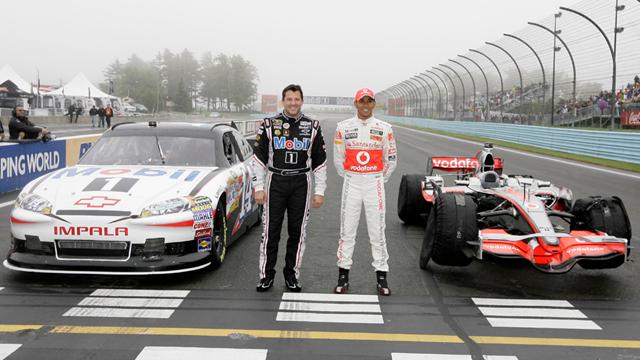
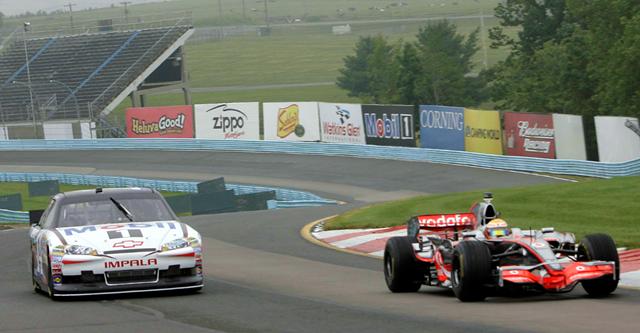
Today, it happened again. The show was called "Seat Swap," and featured a pair of champions. From the world of NASCAR, 2002 and 2005 champion Tony Stewart. And from F1, 2008 World Driver's Champion Lewis Hamilton.
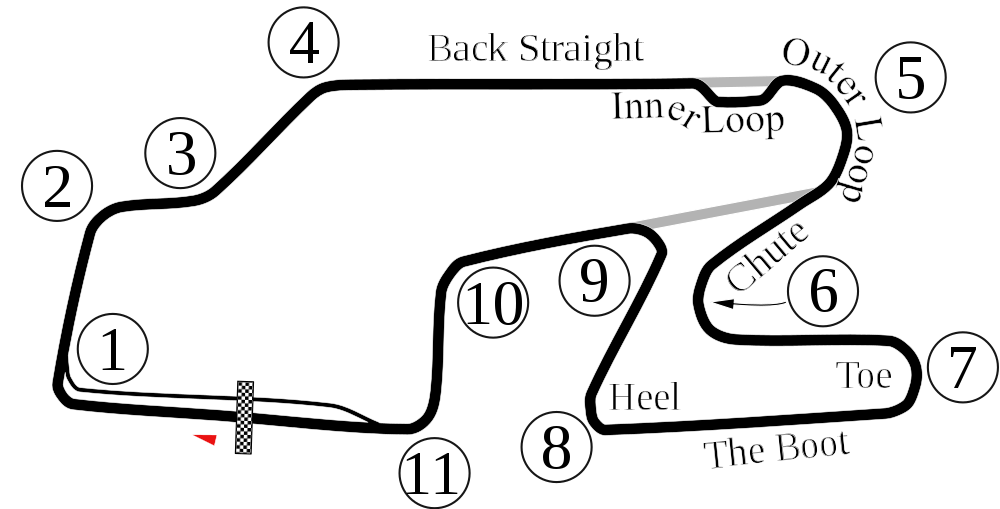
The venue was New York's Watkins Glen International Raceway, once home to the US Grand Prix, now a stop on NASCAR's calendar. Stewart has won five times at "The Glen", though never on the full circuit (NASCAR does not use "the Boot" during their race). Hamilton, of course, has never driven at The Glen before... F1 stopped coming to the circuit five years before he was born. The machines couldn't have been any more different. Stewart brought the road-race version of his 2011 Chevy Impala, and McLaren brought the MP4-23. In case you're not up on your history, that's the 2008 chassis, the car with which Hamilton won his Championship. The weather was iffy, to put it mildly. As a result, the F1 car was using the full wet tires, and the NASCAR had rain tires, I assume from the Nationwide Series as the Sprint Cup won't race in the rain. You'd think this would mean that Hamilton would have something of an advantage, but you'd be incorrect. Stewart might be the best American racer of his generation. Along with his two NASCAR titles, he's also won a championship in the Indy Racing League, midget cars, sprint cars and USAC Silver Crown cars. In other words, he's got plenty of experience in open-wheel racing, and Indy cars are about as close to F1 cars as you'll find here in the US. By contrast, Hamilton had never raced with a roof over his head.
Fortunately for everybody, when the time came for the two to switch rides, the track had dried off substantially. I don't know if the two of them were kidding or what, but both drivers wanted to put on slick tires and go back out after their respective runs. As it was, Stewart probably did a better job in the MP4-23 than Hamilton did in the Impala, but Lewis seemed to have had more fun. Indeed, at one point during his laps, he was actually giggling into the radio as he proclaimed the stock car "Wicked!" On his last lap, Stewart's crew called him into the pit lane. Hamilton promptly said something to the effect of "Sorry, didn't hear you!" and turned another lap. He then finished up with a respectable couple of donuts and a cloud of smoke.
Stewart on the other hand either couldn't figure out where the radio button was on the McLaren's steering wheel or was waaaaaay too busy actually driving to talk. Either way, he was quite impressive behind the wheel of the F1 car, turning laps that would probably be competitive to other F1 drivers on this circuit... or, at least, not embarrassingly slow. HRT or Virgin-level speed, let's say... not bad for only five laps' worth of experience in a F1 car. Alas, no burnouts or donuts for Smoke. I for one really wanted to see him try it. An 18000 rpm burnout would be something to behold, particularly when the engine jumped out of the car and made a bid for freedom. Hamilton's mechanics probably threatened him with painful painful things if he gave it a shot.
Both drivers had huge grins on their faces, both said things like "...the most fun I've had other than driving in (insert race series here)." Stewart went one step farther, though... he invited Lewis Hamilton to partake in his annual charity race, The Prelude To The Dream. That's a late-model dirt track race run before the NASCAR season kicks off, and he said that if Lewis wants to do it, there'll be a brand new car waiting for him.
I wanna see that. Make it happen, Lewis, make it happen!!!
1
That sounds pretty darned cool. But it must have happened quite a while ago; I can't believe that McClaren or Hamilton could sneak away like this in the middle of the season.
2
It occurred Tuesday afternoon, Steven. As far as McLaren sneaking away, they've got two weeks before the next race at Valencia. The race mechanics would be practicing their tire changes in the McLaren factory... now they were doing so in New York on a live car. And Hamilton can't drive the 2011 car until race weekend, of course, so why not?
Everybody involved probably just stayed here after Montreal; they were already in the area, after all.
Posted by: Wonderduck at June 15, 2011 06:58 AM (n0k6M)
3
What a great show! I loved it when Stewart said he wouldn't mind having Hamilton as a teammate. Since Tony owns his own team, he could make it happen!
Posted by: Mallory at June 15, 2011 01:20 PM (WJ2qy)
F1 Update!: Montreal 2011
Rain. We've wanted rain to make an appearance in the F1 season. Rain makes every race better. But what happens when you get too much rain? THIS is your F1 Update! for the 2011 Grand Prix of Canada!
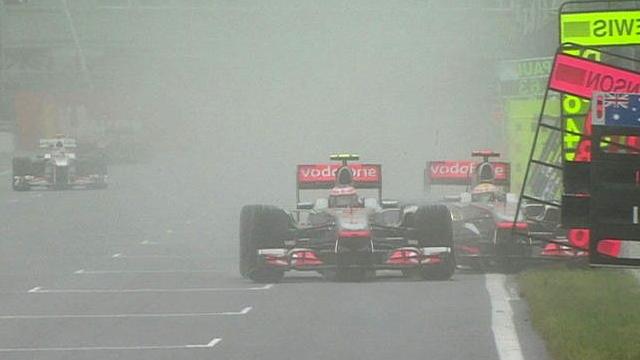
*SWIMMING POOL: An hour before the start of the race, the skies opened up and dropped half the Atlantic Ocean on the Circuit Gilles Villeneuve. As the field made its way to the grid, the decision was made to start the race behind the Safety Car. This meant that, by rule, everybody had to start the race on the Full Wet tires, and that every lap turned behind Bernd Maylander would count against the 70-lap total. For five laps, the field perambulated behind the Mercedes-Benz SLS AMG, the full wet tires creating an obviously dryer line on the track surface. As the thundering herd approached the Hairpin on Lap 3, Maylander turned off the lights on the Safety Car and opened up the 6.2L V-8 engine to pull away while polesitter Seb Vettel slowed down, both to let the the SC get far enough away that the Red Bull would have a clear track for the start, and so he could decide when to step on the gas and gain an advantage over the two Ferraris following. Except two-time World Driver's Champion HWMNBN had a different idea, staying glued to the young German's rear wing in an astonishing display of car control. Everything Vettel did, the Ferrari driver matched for that half of a lap, never getting more than a car length behind yet never in danger of passing the Red Bull, which is a violation of Safety Car rules. Indeed, he did such a good job of anticipating Vettel's tricks that as the two swept down the front straight, HWMNBN's nose was positioned just ahead of the Red Bull's rear tires... probably the best "restart" from behind the Safety Car we've ever seen.
*GREEN FLAG RACING: It didn't last. HWMNBN had to slot in behind Vettel as the two swept through Turns 1 and 2, giving the Red Bull pilot the ability to do what he does best: rocket away into the distance. Behind him, McLaren's Lewis Hamilton bumps into Vettel's teammate Mark Webber in the first turn, sending the Red Bull into a graceful pirouette. No damage to either car, but the Australian dropped to 15th place before he could rejoin the race. For the next few laps, nothing happened as everybody tiptoed around the soggy track, trying to figure out what they could and could not get away with on the Pirelli galoshes. At one point, Hamilton tried to go offline to pass the Mercedes of Slappy Schumacher through the Hairpin, the slowest point of the circuit, and still wound up staggering around like a drunkard. On the next lap, Vettel, despite having nobody in front of him and therefore with no spray from other cars in his face, completely blew his braking into Turn 7 and had to cut across the grass, just pointing out how messy the track was. Despite this, he still had a clear four-second lead over the the second place Ferrari of HWMNBN, and looked like he wasn't ever going to be caught. But this is Canada, birthplace of the Safety Car... surely something would happen to bring Bernd Maylander back out.
*THE NUMBER ONE RULE OF RACING...: "Don't wreck your teammate." That's what everybody says is the first rule of racing. You can wreck yourself, you can punt other cars into the next country over, but if you so much as breathe funny on your teammate, you're opening yourself up to a world of criticism. So it should come as no surprise that Lewis Hamilton, frustrated by Seb Vettel's utter domination of the 2011 season to date and recently voted "Most Likely To Drive Like His Hair Is On Fire, If He Had Any Hair, Which He Doesn't", would do something dumb. On Lap 8, as the McLarens driven by Jenson Button and Hamilton swept down the front straight, Hamilton tried to get by his teammate to the inside. Button moved over to make it a challenge, and instead of playing it cool, Hamilton decided to barge on through. As Hamilton drove onto the grass, the two McLarens touched. Button drove on, screaming into his radio "...what is he, crazy?!??!". On the other hand, his teammate's car smacked into the inside wall, sending the various team's signboard holders scrambling for cover as he scraped by them. His left rear wheel deranged, he tried to make it around back around to the pits, but only made it a few turns before he had to stop on track. Out came the Safety Car for the second time.
*GREEN AGAIN: This time, Bernd Maylander led the race for five laps as the marshals disposed of the broken McLaren. Behind him, Seb Vettel led HWMNBN, and Felipe Massa, while Jenson Button came around and into the pits for a quick checkover and to become the first to switch to Intermediate tires. Once the Safety Car came in, the leading three blast away from the rest of the pack, while Vettel once again shows that he's got the better car, putting 1.5 seconds between him and the Ferraris in one lap. Button, on the other hand, begins to rip off laps nearly two seconds faster than anybody on the full wets but is hit with a drive-through penalty for speeding behind the Safety Car. Whoops. He serves the penalty and rejoins in 15th. There's a mass exodus to the pit lane as teams decide it's safe to put on Intermediate tires. By Lap 18 however, Vettel leads Massa by nearly seven seconds. Gandalf Kobayashi follows the Ferrari, but is still on the full wet tires. Mark Webber and HWMNBN round out the top five.
*AND THEN...: On Lap 20, the skies decide to drop the other half of the Atlantic Ocean on the Circuit Gilles Villeneuve. Once again, Bernd Maylander brought out the Safety Car, leading to yet another mad scramble for the pits and full wet tires. Vettel manages to get in and out while remaining in the lead, but Massa loses 2nd to Gandalf, who doesn't need to pit; he's still on the rubber he started with. Then, much to everybody's surprise, the rain got even harder. Even though he was the leader and therefore had nobody but Maylander in front of him, Seb Vettel radios in that he can't see a darn thing, while Jenson Button complains that he's aquaplaning down the track. On Lap 25, some bright spark realizes that the track is undriveable and throws the red flag, halting the race.
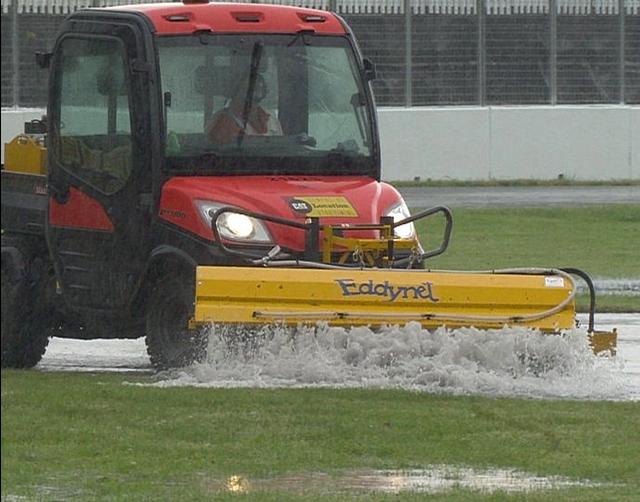
*IT FELL, AND FELL, AND FELL SOME MORE...: The field came to a halt on the front straight, with everybody supposed to stop in the grid spot that equated to their position: First place in the first grid slot, second in the second slot, and so on. Felipe Massa, apparently unable to count to "three", just sort of stopped where he felt like, leading Rob Smedley, his head engineer, to call to him over the radio: "...is it so hard, Felipe?" Cue peals of laughter amongst the Legendary Announce Team. And with that began the longest red flag period in Formula 1 history. For two hours and 14 minutes, the field sat on the grid, umbrellas over the cockpits and tarps over the backs of the cars as the rain continued to pelt down. After a couple of recaps of what had gone on so far, the Legendary Announce Team was reduced to showing clips of past races, praising Montreal to the heavens, and making shadow puppets. Oh, and Rhianna visited the McLaren pits. Cue plenty of "Umbrella ella ella ella" jokes. What F1 needs for rain delays is what baseball has: players sliding headlong into big puddles. We here are F1U! would pay good money to see Slappy bellyflop like that. *FINALLY: After two hours of watching Canadians with brooms trying to push water off the track, they finally decided to restart the race behind the Safety Car. Once again, we were treated to the sight of Bernd Maylander leading the 23 most expensive, technically advanced race cars in the world... in a street-legal car you could, in theory, walk into a Mercedes dealer and buy. For ten laps we get this pleasure, full wet tires pumping the rain off the racing line and accomplishing more in a few minutes than the Squeegee Patrol managed in two hours. But all good things come to an end, and on Lap 35 the SLS AMG turned off its lights and let Seb Vettel take over the field. Immediately, a quarter of the field dove into the pits to make the switch to Inters. On Lap 36, Jenson Button pits to do the same, his fourth stop of the day if you include his earlier drive-through penalty. He rejoins just behind HWMNBN, and is obviously faster than the Ferrari driver.
*OH COME ON: On Lap 37, Seb Vettel is still on the full wet tires, still cranking out quick laps, but he's intentionally driving off the racing line, trying to keep the rubber wet and cool. It's obvious that he's going to need to pit soon, which would throw the entire field into a cocked hat. And then Button tried to pass HWMNBN in the first chicane. The two cars collide, sending the Ferrari into a spin that ends up with the Spaniard high-centered on the curb. And once again, Bernd Maylander takes to the track! Button limps around to the pits, is pronounced fit to continue, but rejoins dead last on the grid. Meanwhile, Seb Vettel took advantage of the Safety Car to change to Inters and rejoin without losing first place. This time, the SC comes in on Lap 41, with Vettel still leading Gandalf and Massa.
*RACING, WHAT A CONCEPT: Surprisingly, we go for 13 laps before anything weird happens. The racing line was dry enough for people to try slicks, and they worked well: nearly three seconds a lap faster than either of the two types of galoshes. It was on these that Button began working his way up the field, taking 10th place on Lap 49, and coming on like a freight train. On Lap 54, Felipe Massa found his way blocked by the HRT of Narain Kittylitter as he chased after Gandalf and Sebby. Going off the dry line to get past, the Ferrari snapped viciously into the wall on the right side of the track, sending the car's front wing off into the forest and actually damaging the nosecone in the process. He'd continue, but would be out of the running. Button makes yet another pitstop for tires, his sixth of the day.
*WHO HERE IS SURPRISED, RAISE YOUR HAND: A lap later, Grizzly Nick Heidfeld bangs into the back of Gandalf. The Renault's front wing detaches, slips under the front tires, and virtually explodes as the uncontrollable car plows into the wall. And once again, the Safety Car is summoned, this time because of all the carbon fiber debris scattered across the track. The standings at this point are Vettel, Slappy Schumacher, Mark Webber... and Jenson Button, having the drive of his life at this point. The Safety Car stays on the track until Lap 61, but not without incident. On Lap 59, before the entire field had been gathered up by the Mighty Maylander, track marshals ran out to start picking up debris from Heidfeld's front wing. One of the marshals, apparently wearing super-soft shoes or unfamiliar with the concept of gravity, took a header... right in front of the fast-approaching Sauber of Gandalf Kobayashi.
Only fast braking and a quick swerve saved us from a Montreal Marshal Massacre.
*THIS TIME FOR SURE: With nine laps to go, the race restarted. Webber and Slappy immediately begin fighting each other tooth and nail for second place, letting Vettel fly away unfettered. Jenson Button is right there behind the two, looking for an opening. On Lap 65, the Red Bull driver, under pressure from the McLaren, blows the final chicane and lets Button past. A lap later, Button barely notices when he go by the Mercedes and into second, so great is his advantage. However, he's a few seconds behind Vettel.
*AND THEN...: On Lap 67, Button turns the fastest lap of the race at 1:17.5, a full second-and-a-half faster than Vettel. On Lap 68, he does it again. And again on Lap 69. Just like that, it's the final lap and Button is less than a second behind the reigning World Driver's Champion. Suddenly, it's Monaco all over again: Vettel has the lead, Button has fresher tires. Button is driving as if he's on rails, while the Red Bull is slipping all over the place. Into Turn 7, the inevitable happens and Sebby slides juuuuuust a bit wide, his tires giving up altogether. He gets into the wet part of the track, and suddenly he's fighting to keep from spinning while Button sweeps past, taking the lead for the first time today. From dead last on Lap 50. A few turns later, the McLaren takes the checkered flag a full two seconds ahead of Vettel, winning in four hours, 14 minutes, 39 seconds: the longest race in F1 history. Seb comes in second, followed by Webber, Slappy, and the Red Menace. Behind the Renault, Felipe Massa and Gandalf are sprinting for the finish line, with the Ferrari beating the Sauber for 6th place by five-hundreds of a second, ending the drama of a fantastic race.
*DRIVER OF THE RACE: Jenson Button. SIX pit stops, one drive-through penalty, and still going from last to first in 20 laps? Oh yeah, driver of the race, right there.
*TEAM OF THE RACE: Red Bull. Okay, they didn't win, but second-third is still a pretty good result, particularly when your closest rival only has one car finish, further solidifying your position in the Constructor's Championship.
*MOVE OF THE RACE: On Lap 51, Slappy Schumacher was in 4th place, behind a dueling Gandalf and Felipe Massa. Coming out of a turn, Schumi began a pass on Massa just as the Sauber driver slid a bit wide. Massa took advantage by passing Gandalf while being passed by the Mercedes driver, a brilliant bit of opportunistic driving by the seven-time World Champion, and a small example of his past talents. It drew a "Holy Sh*t!" from the F1U! team, a jaded bunch of plonkers, that's how good it was.
*MOOOOOOOOO-OOOOVE OF THE RACE: (please see "The Number One Rule of Racing..." above)
Good jorb, Lewis. Still, you got to hang out with Rhianna... that's gotta count for something. Here's your Mooooooooo-oooove.
1
When I was watching the BBC liveblog, and saw that Button has passed Vettel in the last lap, I could imagine you standing up and cheering. Not that you're necessarily a Button fan, but just because it's the kind of ending that a fan of the sport dreams of.
3
Watching both the F1 & Le Man today was edge of the seat, very impressive racing.
Posted by: von Krag at June 12, 2011 06:31 PM (VGXAE)
4
My DVR recording ended right at the restart. ;_;
Posted by: Avatar_exADV at June 12, 2011 09:17 PM (mRjOr)
5
Av, there's a replay on Tuesday at Noon, I believe.
Posted by: Wonderduck at June 12, 2011 10:59 PM (n0k6M)
6
I really wish they could set up a mechanism to inform a DVR when a show runs long. I always record the next time slot after a race for just this eventuality, and even so it wasn't enough.
Posted by: David at June 13, 2011 12:11 AM (Kn54v)
Montreal Monsoon
Less than an hour before the 2011 Canadian Grand Prix and it's pouring down rain at the Circuit Gilles Villeneuve. Of course, it may stop before the race, but the track'll still be damp. Ladies and Gentlemen, we've got ourselves a wet race!
UPDATE: Forgot to mention the little detail that, as long as anybody on-track is using galoshes, DRS is disabled entirely.
Also, Custard d'Ambrosio has been permitted to take to the grid for the race. The stewards decided that, since he needed to have a backup car built for him after his wreck on Friday (the monocoque was broken!), his pace was acceptable in Quals. He'll start 24th.
Saturday Night Tunage
No, not "Saturday Night Tuna," tunage! I haven't done a good music post in a while, and since I don't want to work on the two long anime posts I've got on my mind, this would be a good time!
Click below for an... interesting... assortment of music! more...
F1 Quals: Canada 2011
Leaden, heavy skies awaited the F1 Circus as Quals for the 2011 Grand Prix of Canada got underway, but would the rain come? Or would the galoshes come out for the first time this year? Let's take a look at the provisional grid:
Okay yes, Seb Vettel is on pole for the sixth time in seven races, and yes, his lap was the fastest this track has seen since 2004 when F1 was in the middle of a tire war, used V-10 engines and had huge wings. But the two Ferrari drivers made him work for it. Indeed, both Felipe Massa and HWMNBN were on pole at various times in Q3. Vettel actually had to come out for a second hot lap, something he hasn't done for a couple of races... meaning that he won't have that unused set of super-soft tires in pocket tomorrow. Tracks like Montreal don't really suit the Red Bull chassis, which performs better on low speed circuits. I think this pole lap was probably Vettel's best of the season; he looked so smooth and controlled out there, like he wasn't under any pressure whatsoever.
Yet Ferrari very nearly took the front row from him. Both look strong, but whether that's because the car works well on a low fuel load or if it can truly duel with the Red Bull, we won't discover until tomorrow.
And what of the McLarens? The two of them have to be running a lot of rear wing, for they were dreadfully slow through the speed trap (~190mph, when the Force Indias are over 200). That's great for traction, but then why did they still look twitchy through the chicanes? I can only assume they are running a wet setup on Hamilton's and Button's cars. It's a gamble, but if the rains come they'll be in the catbird seat. And the weather forecast suggests it will rain at some time during Sunday's race.
Further down the grid, bonus points to Pete Rose for making it to Q2. He was given roughly 10 minutes to get ready going into P2, it took the team over an hour to modify the cockpit to fit him (he's nearly six inches taller than the driver he's replacing), he'd never been in the 2011 Sauber challenger, and they didn't even have a Sauber firesuit for him. Yet he still made it out of Q1. Pretty spiffy, that.
Unfortunately, it looks like we'll only have a 23-car grid. Custard d'Ambrosio just couldn't figure out the Circuit Gilles Villeneuve and his time falls below the 107% mark. Unlike in Monaco where HRT was allowed to race because their pace in P3 was faster than their Quals time, Custard hasn't been fast all weekend. Look for him to be on the sidelines when the lights go out on Sunday.
F1 Practice: Canada 2011
To say that this was a weird practice session today in Montreal would be something of an understatement. The dominant color of the day would have to have been red. Red for the three flags brought out for crashes by Red Bull's Seb Vettel, Sauber's Gandalf Kobayashi, and Custard d'Ambrosio's Virgin. And red for the color of the fast car of the day, HWMNBN's Ferrari. P2 in particular was a sloppy, stop-and-start affair that really prevented the teams from getting data on long runs.
Sauber is probably the big loser in P2. Of course, Gandalf power-sanded the right side of his car into dust against the wall. Then, they learned that Sergio Perez won't be racing this weekend, as he's still recovering from the concussion he suffered in Quals at Monaco. Before today, he had been cleared for action by the FIA's medical staff, and he gave it a shot with some twenty laps in P1. There's just no way to predict how someone will react to the real-life stresses of racing a F1 car at top speed, what with the g-loading that wants to rip your head off. After P1, he went to the team and said that he couldn't do it, he wasn't feeling 100%. Smart move by the rookie, that. Unfortunately, Team Sauber don't have their third driver, Esteban Gutierrez, in Canada this weekend. Would have been interesting to see the kid, but that's the way it goes. In Perez's stead, Sauber has asked McLaren for permission to borrow their test driver for the rest of the weekend, and McLaren assented. His name? Pedro de la Rosa. That's right everybody, Pete Rose is back again!
They're expecting rain both Saturday and Sunday... last race saw our first Safety Car of the year. Will we get our first glimpse of the wet tires this week?
In other news from the F1 world...
Bahrain, which was a no-go, then a go-go, is now a no-no. The screams of protest from the drivers (led by Mark Webber), the Formula One Teams Association (FOTA), and the fans were all set to be completely ignored by both Birdy Ecclestone and the FIA... but then Bahrain race organizers pulled the plug on the race this year. Seems they couldn't guarantee the safety of the drivers... or something like that. Color me surprised.
Then there's Virgin Racing. For the entirety of their short existence, their cars have been designed by Nick Wirth. Wirth is F1's leading proponent of designing using computer simulation only... no wind tunnels for Nick's cars, no sirree! Well, Virgin has decided that being the worst team on the grid is getting kinda old and bid Wirth farewell.
Quals aren't until the afternoon on Saturday; we'll be here immediately thereafter! Don't forget that this is the weekend for the 24 Hours of LeMans, my favorite race of the year... yes, it's not all F1 around Pond Central!
2
Nope, he'll be in the car on Sunday. As long as he's in there for Quals, he'll be okay to race... which is why, for example, Sergio Perez couldn't be replaced for the race at Monaco.
Posted by: Wonderduck at June 11, 2011 02:21 PM (n0k6M)
Misunderstanding Midway
Down in the comments section of the post "The Reason for Midway", there's a sight to warm the heart of any blogger: an energetic argument discussion. Longtime readers CXT and Avatar are doing a fine job of carrying the flag of disagreement with Bob, I wanted to pay closer attention to something he said at the very beginning of his comments. To whit:
It will come as no surprise to readers of The Pond that I vehemently disagree with this statement. To be honest, in one way I do agree with Bob in that Japan had no chance of winning an overall military victory against the forces of the United States, Britain, Australia and the Dutch. However, that does not mean that Midway didn't matter, any more than it means that Guadalcanal/the Solomon Islands, Leyte Gulf, Iwo Jima, Tarawa, or even Attu and Kiska, didn't matter.
Once the first A6M2s, D3A1s and B5N2s lifted off from the Akagi, Kaga, Hiryu, Soryu, Shokaku and Zuikaku on their way to Pearl Harbor on December 7th, 1941, sterile discussions over such concepts that Bob mooted became academic: win or lose, the die was cast and everything mattered. Only in hindsight can we say "it was pointless and the Pacific War shouldn't have been started". The fact of the matter is that it did start, men did fight, and it did matter... every bullet fired, every torpedo launched, every bomb dropped, every grenade thrown, mattered.
It mattered to 3400 men at Midway. 29000 men at Iwo Jima. 38000 men at Guadalcanal. 7000 men in the Aleutians. 12000 at Peleliu. And hundreds of thousands more at dozens of other locations across the Pacific.
To suggest that these battles "didn't matter", no matter how large the stack of scholarship one may bring to the table, is ridiculous and insulting to those who participated and survived, those who were there and were injured, and to those who fought and died on both sides. Don't take my word for it, however... walk up to a Pacific War veteran and tell him his actions didn't matter. Just let me know where and when you intend to do it, so I can bring popcorn.
Regarding the first part of Bob's statement, it seems clear that he doesn't read The Pond overmuch. Very nearly by definition, I blog about "the narrow", because that's where my interests lie. Sure, I could write about the geopolitical situation surrounding the beginning of WWII in the Pacific, but I'd hate every moment of it. I'm an amateur historian of the military actions of the Pacific War, with an emphasis on naval battles, and a particular emphasis on the Battle of Midway, because that's what I like... and I write about what I like. I won't apologize for being "too narrow" for someone's taste.
"...that
does not mean that Midway didn't matter, any more than it means that
Guadalcanal/the Solomon Islands, Leyte Gulf, Iwo Jima, Tarawa, or
even Attu and Kiska, didn't matter...." Of course it
mattered. But I believe the people in the steel mills in the
upper mid west, the Manhattan project folks in TN & NM, the
bomber assembly workers in KS & GA, etc also mattered and that
the collective efforts of the home front meant more to the wars
outcome than the clearly heroic efforts of the military at the 'tip
of the sword'.
What
would have happened if the USA lost at Midway? Lost the
Hawaiian Islands? Lost Australia?
There
might have even been fewer front line military deaths! I don't
know. But I do believe that any rational analysis would show a
defeated Japan before 1950. Maybe even before 1946.
There
is no likely case for getting Japan past Hawaii. Existing
submarine forces and the long supply line would have stopped the
Japanese for years at Hawaii. With Japanese actions on so many
fronts, they didn't have the ability to project to our west coast.
In the absolute worst case, the America of 1944 would have
looked about the same. More carrier fleets than Japan, more
submarines and so many long range bombers that the sky would
still go dark when they were overhead. Can you imagine a
carrier fleet being attacked by B-29's (who were protected by P51's)?
And in the worst case, how many nukes would it take to
eliminate the Japanese Navy in 1946/7? Would our 700 (worst
case) nuke inventory in 1950 been enough? The method and path
of winning was not known, that we would win was.
It
is NOT any lack of scholarship OR disrespect for the efforts of the
those on the front line in the Pacific. Both of my parents are
buried in Arlington and my father-in-law spent WWII on a destroyer in
the Pacific (a high risk place to be). It is a simple statement
of fact that was known THEN as well as now. The troops in the
Pacific got the best gear last and the old stuff first. Most of
the military and most of the equipment went to Europe. So did a
lot of the Navy. Our government knew then that Japan was going
to lose. That's why we 'starved' the Pacific war. Germany
was felt to be a much closer case. It wasn't 'hindsight' or
'academic', it was the thinking of the 1941 American
government/industrial complex.
The
only real issue is the one that says the Japanese had to do this and
made a reasonable gamble that an aggressive push against the US early
would get the US out of the war. A long war against a
determined, violent Japan would discourage the US and cause them to
sue for peace. History has made it very and unambiguously clear
that by 1941 the American government/industrial complex was already
gearing up for the long war and was looking full time for a way to
get into a war with Germany. The only questions that are
relevant are [1] Did Japan really have to go to war with the USA and
[2] if they did, would bold, aggressive early actions get the USA to
sue for peace?
So
I'm left with my same three conclusions:
[1]
Really bad staff work by the Japanese military planners
combined with a toxic command structure 'forced' Japan to conclusions
that were not based on an understanding of the American people or
readily available information about the war 'capacity' of the USA..
[2]
A Japanese 'peace at any price' policy might have worked but a
war with the USA would never have a Japan favorable outcome.
Wonderduck:
"... I won't apologize for being "too narrow" for
someone's taste..." I came to the Pond via a thread I
noticed on Steven
Den Beste's
site. I noticed the 'narrowness' because there were several
different entries on Midway. I decided to comment because I
thought the conclusion was wrong and that a discussion would be
interesting. Nothing wrong with being narrow. No reason
to take the geopolitical big view. Midway was an interesting
battle for so many reasons. Midway was an excellent example of
the best of our military and people. Midway was tactically
significant and strategically significant to the military progression
across the Pacific.
But
it was NOT strategically important to the actual outcome of the war.
I thought the discussion on this site went a little too far on
the importance of the Midway battle. I note you have not been dissuaded
from your view and I haven't changed mine either. No change was
expected. The goal was an exchange of views and that has been
achieved. For me, very enjoyable.
Regards
to all.
Posted by: BobReisner at June 10, 2011 04:13 PM (/ZWI/)
2
You can't really come to that conclusion, however.
War weariness did exist. It's easy to say "there were no circumstances under which the US would have accepted anything less than total victory and unconditional surrender", but that's plainly not true from contemporaneous records. This is one of the reasons we resorted to the atomic bomb; we anticipated a tremendous number of casualties in the invasion and we were worried that the public wouldn't support the war to a final conclusion.
Midway was extraordinarily costly for Japan. They lost the majority of their carrier fleet and carrier air arm in a single operation. Change the outcome to a Japanese victory, or even an inconclusive stalemate (say, the US carriers spot the battle fleet and work them over well instead of the Japanese carrier group), and the entire course of the war could have changed.
Does that mean the Japanese could have conquered Hawaii or Australia? Probably not. But having an experienced carrier group to contest several of the initial US invasions would absolutely have raised the casualty count and slowed down the US advance.
Sure, eventually we develop nuclear weapons. But we developed and deployed them at a time where we had virtually uncontested freedom to bomb the Japanese as we liked. But what if we hadn't gotten that far yet? If we were still working our way through the Philippines, if we hadn't taken the Marinaras? Even with nukes, our strategic outlook is quite different under those circumstances.
Would we have used nukes on otherwise-valueless islands to crush the Japanese resistance? You can make the case that we'd have done better turning Iwo Jima into a pile of radioactive glass, for example. You could even see the logic in nuking places like Rabaul or Truk, bases we didn't want to take on directly but didn't really need to occupy either. We might have ended up using as many as a few dozen nuclear weapons in the end, especially if you consider the chance of interception of the bomber, etc. That's a very different post-war Pacific.
Or would we resort to a Doolittle raid, with nukes? Surely we wouldn't have had the luxury to hit only one target, and it's not likely we'd have spared Tokyo under those circumstances.
Posted by: Avatar_exADV at June 10, 2011 07:40 PM (pWQz4)
To back what Avatar mentioned - as Richard Frank wrote in Downfall, there were people in the Administration whose job it was to monitor American sentiment and war weariness, among them Dean Acheson. And they were detecting signs that the US public was becoming war weary by 1945. It is a tribute to the Japanese's attack on Pearl Harbor it took that long to produce the effect, but the Administration was concerned that the Japanese strategy of 'outlasting' the US and the Allies in the Pacific War might actually had a chance of working. Or perhaps just as bad, the Japanese would conclude it was working and thus stiffen their resistence.
Furthermore, as David Evans and Mark Peattie had pointed out in Kaigun, it was primarily because of the Japanese 'sneak attack' on Pearl Harbor that produced the psychological and motivational attitude among the American public for a total war to the finish, with the unconditional surrender of the enemy as the objective. Had the war opened in a different fashion, perhaps by an attack on the Philippines following a formal declaration of war, it is highly unlikely that the US public would have been willing to fight for unconditional surrender - and more than likely that a large part of the American public would have called for immediate talks with the Japanese since the 'Philippines are not worth American blood!'
As for the assertion that the US government 'knew' the Japanese were going to lose - not quite. The US government felt Germany was a more dangerous opponent than Japan and hence needed to be defeated first, but no one ever assumed either of them were eventually going to 'lose'. We have the hindsight that says it is true - but nothing in the deliberation of both the US high command, or the debates among the Allied command suggest that until the end was in sight in either theater.
Posted by: cxt217 at June 10, 2011 08:08 PM (G3oVK)
4
Bob, you're always welcome back, but next time? PLEASE don't compose your comments in Word.
Now then... "I noticed the narrowness because there were several different entries on Midway." Yes, because that's what I'm interested in. You wouldn't criticize a NASCAR blog for not writing about French cuisine, would you? Of course not.
As far as the strategic importance of Midway goes, well, I've said ON THIS VERY BLOG that it wasn't the most important battle of the Pacific War, Guadalcanal was. But saying that it wasn't strategically important to the outcome of the war is just silly. If the results had been reversed, with the US losing three carriers and the IJN zero, (as opposed to 1 and 4 in reality), there's plenty of reason to believe the war would have taken much longer to prosecute. Japan would still have lost, but not until 1946 or 1947, and it would have taken quite a few more nukes in the process.
That's important.
Posted by: Wonderduck at June 10, 2011 08:09 PM (n0k6M)
5
And fortunately I neglected to mention the fallacy that the US "knew Japan was going to lose." CXT covered it nicely, didn't need my duplicate input at all.
There is a school of thought, both during the war and after it, that says D-Day and Normandy was an 'unnecessary' invasion - heck, the British kept pushing that idea until FDR let Stalin essentially shamed them into dropping it. Make that what you will.
And regarding Avatar's point - B-36 bombardment groups, from Hawaii.
Posted by: cxt217 at June 10, 2011 09:09 PM (G3oVK)
I'd like to endorse Downfall as well. It's the best work I've ever read on the end of the Pacific war by a long way.
Posted by: Avatar_exADV at June 10, 2011 09:13 PM (pWQz4)
8
To feed off of cxt217's comment, I've been reading a lot of histories of the Eastern Front, and saying the outcome there was pre-determined is also a bit of a mistake. A lot of the newer histories are drawing on previously-classified Soviet archives which indicate that through mid-1943 the situation was a lot more desperate than they were willing to let on, either at the time or in official Soviet post-war histories. By the time of the battle of Berlin, the Soviets were also reaching their limits, and their operations changed from the carefully planned Bagration-style offensives to more of a frenzied 'lets just get this over with and throw everything in' final assault.
Of course Stalin wanted the Western allies engaged against Germany to draw German forces away from the front, and was disappointed in the level of support he felt he was receiving. Even relatively minor distractions like Sicily had noticable cascading effects on German strength in the East.
Posted by: Civilis at June 10, 2011 10:22 PM (/+Ti8)
9
The B-36 Peacemaker was the first true intercontinental bomber, designed in 1941 when it was looking grim for Britain. It didn't fly until early August 1945, however. Roughly twice the size of a B-29, as designed it used six radial pusher engines. Eventually it also mounted four jets along with the radials. Good article about it here.
I'll third the support for Downfall, though there's a new book by DM Giangreco that I've heard good things about, entitled Hell To Pay. Same topic as Frank's book, I've been wanting a copy for the past year or so...
Posted by: Wonderduck at June 10, 2011 10:32 PM (n0k6M)
F1 on TV!: Montreal 2011
Ah, Canada. A place where they put gravy on french fries and call it a delicacy. Where maple syrup would be the national beverage if they didn't have Labatts. A land where bacon isn't bacon. Where death by moose is a serious possibility, even in your living room. A nation whose best restaurant is Tim Hortons. Their football is played on a 110-yard field, their baseball is played indoors, and their greatest cultural icon is Celine Dion.*
But damn, do they have a helluva Formula 1 track! Let's take a look at the map for the Circuit Gilles Villeneuve:
Built on a man-made island in the Montreal section of the St Lawrence River, the track is 2.71 miles long, very fast, and brutal on both brakes and tires.
Brakes suffer here because of the abrupt stop-and-go nature of the circuit. On this layout, you're either going ridiculously fast (200+ mph is the norm here) or ridiculously slow (see Turn 10 or Turn 6/7). That's hard on the brakes for two reasons: first, there's just the effort required to slow the car down from 200mph to 50mph or less; that takes its toll on the carbon/carbon material. Second, the brakes tend to glaze here. The brake material heats up to the point where the very top layer begins to melt... then is rapidly cooled by the unending straights. This makes the brakes less efficient, meaning they need to work even harder and get hotter and melt more... then they rapidly cool off. Rinse and repeat for 70 laps. You don't see explosive brake failure very often in F1, but when you do, it's undoubtedly going to be here.
Tires die miserable deaths here due to a tarmac that has the odd properties of being abrasive, yet not particularly grippy. This lack of surface grip is why Pirelli is bringing the same tires as the ones used in Monaco: the softs and super-softs. Nowhere is that need for grip needed more than at Epingle, better known as the Hairpin. Not only because of the tight bend and the need to decrease speed in a hurry, but because of the ever-present danger of Marmots. Like this one in 2007:
Or this one the following year:
Or this one:
Oh wait, that one isn't a marmot at all, but a Japanese track worker trying to run in front of Seb Buemi during a fundraiser in Japan for the victims of March's Earthquake/Tsunami. Believe it or not, the doofus is fine. So is the guy who tried to cross the track in front of a F1 car.
Anyway, the nicest part of the Grand Prix of Canada is that it's run here in North America. None of that "getting up at 4am" crap for this race! It all kicks off with live streaming coverage of Practice 1 on Friday morning, from 9am to 1030am! Then Practice 2 is also live, this time on SPEED, from 1pm to 240pm.
Saturday brings streaming coverage of Practice 3 from 9am to 10am, followed by live coverage of Quals on SPEED, again from 1pm to 230pm.
The 2011 Grand Prix of Canada will be Sunday, live from 12noon to 2pm... on your local FOX affiliate. Yes, that's right, it's that time of year again. At least the Legendary Announce Team will be on hand to do the honors.
And so will the F1U! team! See you then!
*I kid the Canadians... but only because I know they're too polite to actually complain about it. Ha!
Missing Midway Photography
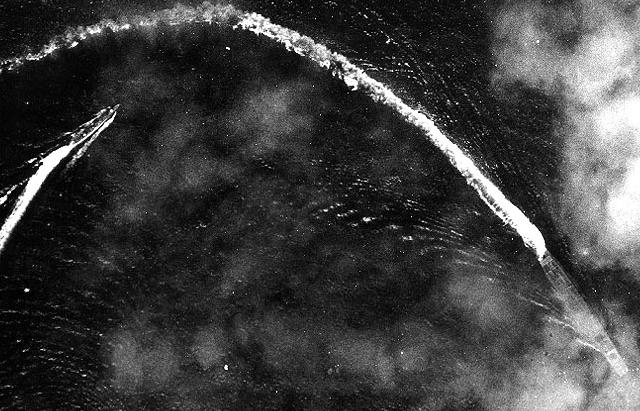
Unless you're like me, and heaven help you if you are, you may not have noticed one of the most surprising facts surrounding the Battle of Midway. That is, where are all the pictures of the Japanese carriers? Now, I can hear you saying "Wonderduck, there's plenty of pictures of Kido Butai at Midway out there! Just look at this one of the Akagi!"
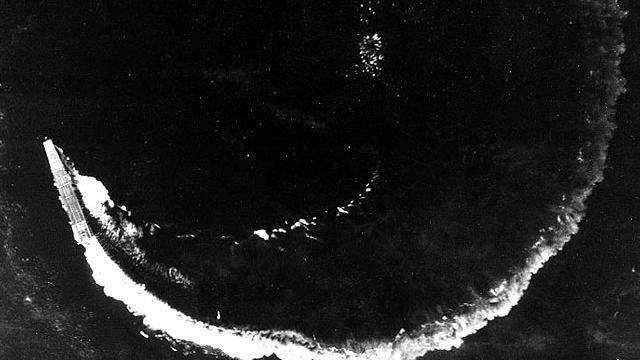
"Or this one of the Soryu!"
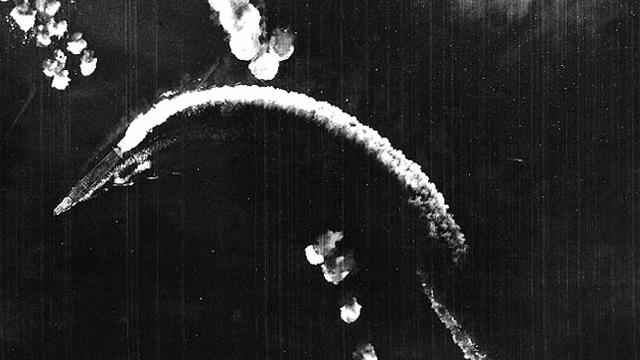
"Or this one, it's the Hiryu!"
"Or this one, of the Kaga... er... hey!"
I'm sure there are variants of the above three pictures in the National Archives, but for all intents and purposes, those are the only images of the Japanese carriers involved at the Battle of Midway that we have. Taken from B-17s on the morning of June 4th, 1942, they represent the entirety of the US photographic effort during the battle.
The Reason For Midway
Reader Siergen asks: "Assuming that the Japanese had succeeded in taking Midway, did they have any plans to actually use it, such as for land-based bombing of Pearl harbor? Or was it intended solely as bait to lure the US carriers out and sink them?"
A fine question. Indeed, there was a strategic reason for the Japanese to take Midway. However, in my estimation, their reasoning was somewhat... flawed. As the War in the Pacific drew close, the Japanese military knew that they could not realistically go toe-to-toe with the United States for more than a year or so, two years maximum (let that sink in: they started a war they could not win militarily... and knew it). Instead, they intended to win politically, by inflicting such heavy losses on the US and her allies that they'd give up and go for a political settlement. In the political realm, they believed that they'd have a strong case for keeping their conquests (primarily the Indonesia area, with her rubber, tin and oil deposits) and become both self-sufficient and the unquestioned master of Asia.
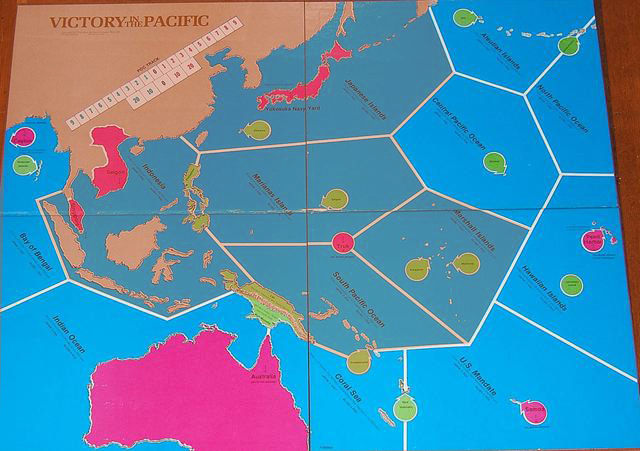
To do this, the Japanese adopted a strategy that relied on the concept of a defensive perimeter. They figured that if they captured enough island bases, like Wake, Guam, Rabaul, and the Philippines, then improved them to stronghold status so they'd be impossible to re-take, they'd be able to create an impassible border that would keep the Japanese Home Islands secure. Along the way, they'd also attempt to sever the lines of communication between Australia and the US, though that would be more of a bonus than a goal. It's hard to imagine the strategy without looking at a map, so let's use a simplified one: the board for the game Victory In The Pacific, by Avalon Hill.
This would be the situation going into June, 1942. The shaded zones are controlled by the Japanese, the lighter areas by the US and her allies. The defensive perimeter is starkly evident this way, along with the one weak area in the strategy: there are two open paths directly to the Home Islands. The first is from the "Hawaiian Islands" area directly through the "Central Pacific"; the other, through the "North Pacific" and "Aleutian Island" zones.
Prior to the Doolittle Raid, there was quite a bit of debate in the Japanese military command as to what the next targets would be... in effect, they had been so successful so quickly, they outstripped their own plans. But then the attack using B-25 medium bombers, flying from the deck of the USS Hornet, made clear that the Home Islands were still vulnerable, and the plans to attack Midway and the Aleutians were approved. Capturing those "areas" would prevent any attacks to slip through without being discovered and countered, either via ships sailing from Truk or from Japan proper
There was never any plan to use Midway as a point to launch aerial attacks on Pearl Harbor; even for the incredibly long-legged Japanese aircraft, the 1300 mile flight was too far a distance. Instead, it would be a self-defending base able to send reconnaissance flights out to patrol the waters around it. Just how the Japanese would be able to keep Midway supplied was never really answered; they would figure it out when the time came.
The flaw in this strategy is that the real world isn't a game board with zones of control that prevented enemy movement, yet in effect that's exactly how the Japanese were looking at it. The Pacific Ocean is huge, particularly in the Northern and Central Pacific areas, with vast stretches of open sea where ships could sail without ever being noticed. Indeed, the fleet used in the attack on Pearl Harbor took advantage of this fact on its approach.
The attack on Midway had the goal of sinking the American aircraft carriers, no mistake about it... but defending the Home Islands was the primary goal. That the strategy behind the goal probably wouldn't have worked was apparently never considered.
1
Thanks for the response! I also read that the natural resources in the captured territories were insufficient to make up for the embargo from the US - and the Japanese knew it before they started the war. If true, that meant not only did the Japaneses need for America to give up militarily within a year or two, but they also needed the US to "forgive and forget" and lift the trade embargo...
Posted by: Siergen at June 04, 2011 10:45 PM (FiHIo)
I don't know that this was really correct. It's true that they never did get the Indonesian oil fields up to the kind of production they really needed, but that wasn't foreseen before the war.
Their biggest problem was shipping, and not just because of the American submarine blockade. They handled their cargo ships suboptimally, because the Navy insisted on owning some of them and the Army did the same, and they didn't really coordinate their usage. So when the Army sent out ships full of troops and supplies to some region, they came back empty instead of bringing back raw materials. When ships were sent out to get raw materials, they went out empty. They could have substantially increased the efficiency of their cargo shipping if only the Army and Navy were more willing to cooperate.
It was not simply a misallocation of shipping. Japan, despite having the third largest merchant fleet in the world in size, and the most modern and efficient in quality, did not have enough shipping under the Japanese flag to handle the traffic needed in peacetime, let alone the higher shipping requirements in war. And this does not include the shipping needed for various campaigns (During the later days of the Guadalcanal campaign, the Imperial Army was pressing for major diversion of merchant shipping to support the campaign, despite being told to their face that such diversions were going cripple the overall war effort.) or the requisition of merchant ships for other purposes (Like conversions to escort carriers, minelayers, auxilary cruisers, etc.).
In fact, at the outbreak of the Pacific War, 60-75% of the Japanese merchant fleet had been requisitioned for direct use by the service or in the opening campaigns, leaving very little support the war effort as a whole. For the tanker fleet, it was >80%. No Allied planner would have dared being stupid enough do something anywhere like that.
Posted by: cxt217 at June 05, 2011 02:56 PM (PKA/z)
4These discussions are interesting but so narrow as to be misleading. The entire Midway exercise didn't matter...regardless of outcome. The overall outcome was foreordained by the differential in GDP and the resulting delta in war production. While I have some issue with specific entries, this web site is directionally correct ( http://en.wikipedia.org/wiki/Military_production_during_World_War_II
. The war was decided on the size of the prewar industrial base and the ability to ramp. The military efforts were heroic and certainly helpful, but the outcome was decided in the dull, boring (pick your term) factories of domestic USA. The Japanese didn't have even two years...if not for the forced entry into the European conflict, Japan would have been finished years earlier. Japan could not have been certain of simultaneous entry of the US into the European conflict. Any Japanese planning for a short war absent US involvement in Europe was idiocy even if only public source information was available. Note the 1938-1941 difference in GDP between Japan and the USA. The GDP impact is cumulative.
Even if the US had been pushed back to continental US the outcome would have only been worse for the Japanese. In this case, the wars human impact on the US population would have been quite modest and the resurgent economy (due to war production) would have made it 'easy' to stay the course. Imagine a Japan in 1946 that owned the Pacific but was facing a US with long range bombers, scores of carriers and hundreds of nuclear weapons. The post war period saw the development of 700 nuclear bombs by the end of 1950. Imagine a wartime scale up of the nuclear production! Forget Japanese cities....think of Japanese fleet or forward airbase survival in the face of a single bomb that only had to be somewhat close.
After 60 years we should be able to take a step back and understand what really happened. And what was really important.
Posted by: BobReisner at June 07, 2011 02:29 PM (/ZWI/)
Bob, none of those things matter if the people of the rich country, or its leaders, don't have the guts to see the thing through.
The Japanese thought that was the case about the Americans. Even if you outproduce your enemy five to one, it still costs blood to win a war, and the Japanese thought that the Americans wouldn't be willing to shed enough blood to win.
That was their plan: after Pearl Harbor, to take and hold so much territory that the butcher's price of taking it back would be so high that the Americans would give up and make terms.
They weren't the first to make that mistake about America, and they weren't the last.
Everyone on the Japanese side thought the US would outproduce and outmass them if and when the Pacific War broke out. Everyone. You can argue they underestimated the production imbalance between the themselves and the US, but that is a different matter.
And barring the more extreme delusionists (Gerhard Weinberg in A World At War make for interesting reading on some of the more grandoise schemes of the Axis.), no Japanese thought it was possible to subjugate the US militarily - though quite a few Japanese recognize the US could do so to Japan.
Those were not the points. The Japanese thought they could wear down the Americans' will to continue fighting, that the Americans, confronted with an invincible Germany on the other side of the world (And YES, the Japanese WERE assuming the Germans would play a role against the US - by knocking Britain and the Soviet Union without Japan having to do anything, if nothing else.) would come to terms with Japan that would leave the Japanese in control of a vastly larger empire.
Posted by: cxt217 at June 08, 2011 08:01 AM (PKA/z)
7I understand the assumption of foreign states of a lack of resolve by American citizens and an expectation of a US citizen desire to end any conflict early and at any cost. I understand this because I see this assumption being made repeatedly over the centuries. But, I also believe the foundation for these assumptions is not scholarship but simply wishful thinking. Any review of American open source history should have warned them otherwise.
American history from the French & Indian War to modern day is a history of substantial citizen minorities acting with incredible violence over protracted time spans. The American Revolution was a long war that was violent and resulted in a significant number of Americans being exiled from their homeland. Modern warfare (WWI & WW2 style) was created by the American Civil War...violent, industrial, encompassing the whole of society, and with little quarter given. If the Civil War was an example of American brother on brother violence, why would any foreign entity expect that the American reaction to foreign assault would be less violent and with less resolve. It was a very indifferent citizenry that was dragged into WW1. But still a speed and size of mobilization that was shocking even to the 'experienced' European warriors. WW1 was a war without real passion on the part of the American citizen, but American history and politics clearly showed that an aroused citizen minority could hold a grudge for a very long time.
While the Japanese right of passage on to the world stage was the war with Russia, could they not have not noticed the American crushing of a similarly waning power, Spain, with even less effort. Could the Japanese not notice that the Depression crushed America, indifferent to foreign affairs, had the blue water navy that they were most concerned about? In 1931 (Depression well underway), the Navy had 3 Carriers, 12 Battleships, 107 Cruisers/Destroyers, and 56 Submarines. On December 7, 1941: 8 Carriers, 17 Battleships, 222 Cruisers/Destroyers and 112 Submarines. ( http://goo.gl/9KAMi ) A Navy of this scope does not happen overnight, it is an activity that takes generations. And the Navy of late 1941 was a product of an economically distressed country under a great measure of political upheaval. It is worth noting that by late 1943 (only 2 years after Pearl Harbor), the US Navy size was greater than the combined fleets of all other countries on the planet. Was their not a single Japanese analyst in the prewar period who could extrapolate existing shipbuilding capacity (1941) to a war time condition and determine that annual ship production was quickly going to be greater than the total Japanese 1941 fleet size.
In an open society there can be significant minorities that will protest for peace visibly and even irrationally. American history shows that the 'war like' minority always holds sway and, while there can be noise, the ability of the American government to mobilize huge armed forces and the supporting industrial society for long periods and across varying economic conditions is always the case. Perhaps our enemies are distracted by our discordant environment, something that doesn't exist in closed monolithic societies. But it doesn't matter. In matters of life and death, our enemies are under a societal obligation to develop the analytical resources that can see past the noise to the true conditions. They never do and are doomed to make unfounded assumptions that cause their societies to collapse. The information to make a correct assessment about American capacity and 'will' were in the open and available to the Japanese (Yamamoto knew). The "Two Oceans Navy Bill" (July 1940) authorized 1.3MM tons of new warships, the 1939 Industrial Mobilization Plan gave the world notice of massive mobilization, in May 1940 the Office for Emergency Management and National Defense Advisory Commission were created to accelerate war planning, and in January 1941 things really started rolling with the new Office of Production management --- years before open hostilities, the American society was years into a long term commitment to war. All in the open. For anyone to see.
It was over before it started. Midway didn't matter. The Japanese had many better options and would have likely pursued them had they had a rigorous analysis of the American reality, economic and strength of will.
Posted by: BobReisner at June 08, 2011 11:08 AM (/ZWI/)
You make a lot of good points, Bob, and we can agree to the preposition that any war started by Germany and Japan against the Allies was ultimately doomed to defeat (Though it was not apparent to all the participants at the time.).
But in many ways, it did not matter. Both the Japanese and the Germans knew that once America entered the war, they would be outproduced - heck, the British outproduced Germany in ships, aircraft, and tanks by themselves. And the Japanese were under no illusions about the possible size of the US Navy after the Two Ocean Navy bill/Stark Plan.
But it was the Japanese' consideration about whether the US had the will to fight them - especially with a victorious and apparently invincible Germany waging war against them at the same time - that represented their thinking. That actually has some validity to it, since as Richard Franks pointed out in Guadalcanal, the Japanese had gotten a pretty sense of the domestic mood within the US in 1930s and 40s, including how the Selective Service was renewed by a margin of a single vote in the House. Any doubts about both American and Western will to fight was shared, in private, by none other than Winston Churchill, following the fall of Singapore and Tobruk. And the willingness of the Japanese to fight and die to literally the last man, and how that would impact American preceptions - that was what the Japanese expected before the war which did cause American concern during the war.
The huge productive advantage the US had is what caused the Japanese to plan on a short, decisive war of conquest before coming to terms with US - similar to how the mighty hosts of her surrounding enemies had caused two generations of the German General Staff to plan for a short, decisive war to knock out their opponents in sequence before they could be fully mobilized and act in concert. Given the Japanese' apprisal of American opinion and the massive increase in US naval strength that was coming, that seemed a workable strategy to them. The fact it was myopic is correct but in many ways, irrelevent.
Posted by: cxt217 at June 08, 2011 10:33 PM (PKA/z)
9
So the japanese believed they would win. What if Japan would never have attacked Pearl Harbor, what if they had left US alone and concentrated on carving a huge empire from China, Soviets and european colonial possessions? Would US have done anything? What could have been the triggering point?
Posted by: Ari at June 09, 2011 01:22 AM (QXAzG)
10
The problem is that Japan wasn't completely independent of the US. They required significant shipments of raw materials, including a lot of scrap steel, in order to keep their economy going.
One of the triggers that prompted Pearl was the suspension of oil and steel exports to Japan in mid- to late 1941, in response to their continued invasion of China. Once they were in that position, they couldn't just coast along as they were; access to oil was absolutely required in order to continue with the military obligations they had and the civilian economy. So they had to get access to oil, and that either meant moving against SE Asia or backing down in China.
It's extremely questionable whether backing down in China was actually an option. Any civilian government that tried it without the military would have immediately been turfed out - the Japanese system required the army and the navy to provide a minister each, and they could undo a government by refusing to do so. On top of that, anyone who advocated such a policy would have been highly likely to be assassinated.
Could Japan JUST have attacked SE Asia without the US? Eh. It's not impossible. But if the US decided to make a point of it, it would have been easy to base the fleet at Manila, and there wasn't any way to run oil tanker convoys past a hostile Philippines. So they ran the risk of being pulled into war under circumstances that would have been much more favorable to the US, while still being at risk of getting fuel-choked at any time.
Posted by: Avatar_exADV at June 09, 2011 12:37 PM (44ahZ)
11
I intend to post a response to Bob tonight. It will come as no surprise that I strongly disagree with his initial statements.
Posted by: Wonderduck at June 09, 2011 12:57 PM (OS+Cr)
Avatar: I would argue that a Japan that avoided war with the US and only attacked British and Dutch interest would have gotten away with it, at least for a little while. They had two domestic US factors going for them - the strongly isolationist mood of the US population at the time, and intention of FDR to go to war with Germany first while trying to maintain peace as long as possible with Japan. A US public that saw the Japanese avoid attacking American interests (In the Philippines and elsewhere.) and avoid attacking Pearl Harbor, would not have been in a mood to declare war on a Japan that was overrunning Malaya and the Dutch East Indies.
Furthermore, the Philippines were not logistically prepared for a large American force to be based on - primarily because of its vulnerability to being attacked by the Japanese. The ability of a December 1941 Pacific Fleet to do so was also questionable, given the priorities and allocations of forces to the Atlantic and against Germany - something that frustrated Husband Kimmel and his staff to no end.
Posted by: cxt217 at June 09, 2011 02:23 PM (PKA/z)
13
cxt217 in #12 get's it exactly right. By late 1941, the US had clearly decided that Germany was the opponent of choice. A relatively small island nation that knew it's limitations would have seen a path to real victory as anything other than an attack on the US. A treaty that limited China area conquests to Korea, Manchuria and northern China would have taken 'China' off the table and the American population would have lost total interest. Since France and the Netherlands had been conquered by Germany, Japanese protection in force of these and also German assets in the pacific would have likely been welcomed. Think of Japan assuming the role of a limited regional power that allowed the US and Britain to focus on the European/Mideast/Africa theaters. Japan could have easily positioned itself as an ally. An ally that would have been welcomed and whose activities to 'keep the neighborhood safe' would have been overlooked (think about treatment of Russia). It would have taken generations to integrate the arc from Indonesia to Manchuria into a real East Asia co-prosperity sphere, by 1941 japan had conquered almost all it really needed to be strong for the next 100 years. And it would have had some very appealing post war geopolitical considerations...a strong ally aligned against a weak China (likely communist) and a resurgent Russia. A very different Pacific and maybe a very different world picture with Russia having a heavily militarized Japan on the ground in Asia just below the empty Siberia.
Avatar in #10's point about a base in Manila is a stretch. A fleet would be hard to supply and Manila would be vulnerable to submarine blockage and air attack from Formosa. Plus what cxt217 said in #12. A smart Japan could publicize American attacks on still 'friendly' Japanese shipping and it would be extremely difficult for an America at war with Germany to get popular support for an attack on the Japanese fleet. Again, the only thing Japan had to do was to go out of the way to NEVER declare war on the US and to never engage in a first strike. Germany was at war with Britain for 2 years without the US stepping in as a declared partner of Britain. Yes we defended convoys, took some aggressive actions in the Atlantic and beefed up western hemisphere defense but we did not engage Germany despite provocation. Based on this example, why did Japan think the US would actively engage Japan in defense of Britain in the face of Japanese aggression against British conquests. Just another case of bad analysis and bad thinking.
Again on Avatar #10, I think the issue of US oil and scrap steel export to Japan (or rather lack of export) was not really important. Any war with the US would be the same as the export ban....nothing would come from the US to Japan with a state of war in place.
But Avatar in #10 makes my case exactly when he states the very true statement that NO Japanese government would have survived a China retrenchment or likely any military stand down / stabilization. The combination of an insular society, emperor worship and the blind desire for territorial conquest created the perfect storm to assure that all problems had the same answer of military expansion. Post war documents clearly showed that Japan had no realistic plan to stop and that there was no real post war plan, plan to end hostilities or even to 'integrate' the conquests into a rational economic system. True analysis and realistic selection of realistic options was not possible in the religious and political structure that was Japan. The choices made were to recover from ethnic/societal slights and feed the military desire to acquire territory. What other possible explanation could there be for so many bad strategic decisions. It wasn't random bad luck. Ari's point in #9 is so obvious, how could the smartest people in Japan 1941 missed that train of thought.
The linchpin of the discussion rests on two apparent thoughts about the American people by the Japanese leadership: the Americans didn't have a stomach for a long war and they were too 'soft' to fight a determined enemy. We know that these statements are not true but it is my contention that the Japanese could have determined this in 1941 from a careful reading of public source information and American history. Their (the analysts) desire to support ethnic supremacy, their feeling that other societies were structurally inferior, and that they must provide analysis that supports the predetermined conclusions of the emperor and military caused the Japanese disaster known as WWII. I won't repeat all of the prior points but I want to address some of the examples in #10. A close vote on Selective Service was nothing compared to the draft riots of the civil war (which did not affect the conduct of that war). Again, the American revolution and civil war showed conclusively that Americans would fight each other to the last man! If Andersonville showed how Americans would treat their own, what lesson should Japan have taken away? The American propensity for violence was in every newspaper every day....machine gun toting bank robbers, gangland wars in New York, Chicago and Detroit, UAW and other union organizing activity, veteran pension marches (and the government response), California efforts to restrict 'immigrants' from the mid west, ethnic violence on every group that ever migrated to the US in size (Irish, German, Italian, Jews, Chinese, etc.), and of course White on Black actions. As all of this is compared to the relatively peaceful, very structured, very stable Japanese society, I can only ask: Exactly what information were the Japanese analysts missing? A violent people that could hold grudges across many decades.
I do understand that casual viewing of dissent in American political life (and in America in general) could lead those with limited information and understanding to a conclusion that the American society could not be mobilized for war (despite what happened in the Spanish American War and the BUND rallies in the 30's). I do understand that isolationist marches and vocal 'peace at any price' fringe groups could make an impression of weakness on the ill informed. All white people look and act alike so yes, America should collapse like the French, Poles, Austrians, etc did in the face of German intensity (forgetting that Germans were also 'white'). And Roosevelt and his team didn't know about war and were only interested in the domestic economy. And so on. BUT, the analysts and war planners are not supposed to be casual viewers of limited information. These analysts were expected to be 'the best and brightest'! They should have made the effort to learn and understand. They had 2 decades and no externally imposed resource constraints...one less battleship in a 20 year period would have provided the funds to send hundreds of soon to be senior staffers to the US for a decade to learn about us. Of course, the 'visitors' would be so contaminated by the US that they could never assume a senior analysis position in the Japanese hierarchy!
America is a noisy society with many components wanting isolation and peace at any price. My belief is that America always has a range of opinion and it is a specific vocal minority that carries the day. The guy's with the guns. About 1/3 (an unsupportable guess) of America is deeply 'conservative' and they tend to run the important government agencies (Senate, State, Defense, local governments), banks, industry, religion, and the actual military. While other minorities can have impacts on the edge and minorities overlap, there is a core to the US that has acted in a very predicable way (not necessarily right) since our founding. We see it and others can as well (or should).
It wasn't Midway, just really bad staff work. All the answers were available. There were good choices to be made (from their view). The only impediment was a closed mind. Turns out to have been a pretty big impediment.
Posted by: BobReisner at June 09, 2011 04:35 PM (/ZWI/)
Bob, sorry but as much as you have some valid and good points - you are not going to win this argument. Your argument about the Japanese' lack of looking at American history ignores that fact that it was very much the Present America and World of 1940-1941 that was the determining factor in Japan's (And Germany's, to a lesser extent.) decision to go to war, in so far it as the apparent lack of will in Americans to fight a war. The Draft Riots of the Civil War are interesting for a Japanese examining American history - it is also largely irrelevent to determining whether Japan was going to war in 1941. Much, if not most, of the American history you cite as being 'missed' by the Japanese were completely irrelevent to the deliberations at hand.
Also, if we are going to look at American history - how about the fact that Americans previously have seldom enjoy unanimus support in going to war? There are been a large segment in almost every war (Barring WW2 - and that still did not prevent one congresswoman from voting against a declaration of war on Japan.) that believed their fellow Americans were making a grave mistake in going to war against whomever. Sometimes this has led to more active anti-war efforts during the conflict. That would seem to argue that the Japanese assessment of Americans might be correct? Likewise, determining how European countries would react to Germany's invasion of Poland on 1 September 1939, by the using the European history regarding the mood in August 1914 might a tad off.
It is important to read the other guy's history but you have to be careful reading significance into it. Japan's defeat at Midway and in the Pacific War was the outcome of a whole host of factors, some of which no one could anticipate and some which could and should have been anticipated by the people of the time - but your overall position really is not one of them and, in my view, not supportable.
Posted by: cxt217 at June 09, 2011 05:19 PM (PKA/z)
15Sorry to hear that cxt217 in #14 thinks we are having an arguement....I really do think it is a discussion ;>)
I'm also a poor communicator...most of the comments in #14 I agree with and feel support my point of view!
The Civil War draft riots were brought up as a counterpoint to the comment about the Selective Service Act being passed by a single vote margin and how this shows a reluctant America...that by implication would 'freeze' aggressive action by the government. The riots didn't and a single vote wouldn't. I also think that other countries should look at the long history of a people. Clearly much of France, to pick one example, has been and continues to be influenced by the French revolution, Napoleon, 1870, 1914 and of course WWII. The distant past is important. I believe this is true for most countries European, Asian, etc..and of course the USA.
I'd ask (cxt217) why you think American history in general and my specific references to the violent nature of Americans in the 1930's doesn't serve as an indicator that Americans can be violent (and self organize for violence) and hold grudges for a long period. As well as a multi year defense ramp up being well underway by 1941. cxt217 says "...how about the fact that Americans previously have seldom enjoy unanimus support in going to war?..." My point exactly! With the possible exception of the Spanish American War (made unanimous by a 'sneak attack'!), the US had a long history of going to War with significant (perhaps majority) dissension. How could the Japanese have missed this? I'll respond to the third paragraph of #14 in a post on the next thread but my line of discussion is NOT about the Japanese defeat at Midway being "...the outcome of a whole host of factors...". Of course it was. My point was and is that the Battle of Midway, while heroic, was not really important in the outcome of the War. And that with the perspective of 60 years after the fact, we should start to acknowledge this. (Not having to do with this discussion, the cxt217 comment "... Likewise, determining how European countries would react to Germany's invasion of Poland on 1 September 1939, by the using the European history regarding the mood in August 1914 might a tad off..." seems inappropriate on its face. In 1914 Europe went to war on the basis of an assasination of a single person who wasn't really all that important. So if Europe could go to war over a single death, why not a possibility over a single country? Most historians weren't surprised...the exhaustion of WWI created the anomily of Austria and Czechoslovakia, not the other way around.)
Posted by: BobReisner at June 10, 2011 03:01 PM (/ZWI/)
First, I was error when referring to this as an 'argument' the way I did. We are having a discussion - all parties are advancing their arguments (i.e. position.) in the discussion.
The point is that trying to read history as an example what a nation or a people will do later, can be dangerous if you put more significance than the part of history is worth. Yes, America has gone to almost all its wars with large segments of the population dissenting (I would argue even the Spanish-American War qualifies, since there were a number of people, up and including William McKinley, who thought it was very bad idea.) and it has impair but not froze its action. I suppose the Japanese could have read that as warning - but they could also read that any war in 1941 that involved the US would not be whole-heartedly supported by the people, and would have a major segment of the American population seek negotiations and peace as soon as possible, and that the peace movement who not freeze the effort - but it would impair so much that the US government would not able to concentrate its whole attention on the war and would spur the US (Especially faced with an invincible Germany too.) to seek peace with the Japanese.
Note that historically, the US has ended every war prior to 1941 except the Civil War with...a negotiated settlement. And had the stalemate that persisted outside Richmond/Petersburg and Atlanta lasted longer in 1864, we might not have the exception either. That would suggest to a Japanese studying American history that the US would eventually come to the negotiating table with Japan as equals to end the war - after all, Americans always become war weary and want it to end, one or another.
And the build-up of American military power prior to 1941 would have argued for Japan to wage a short, decisive war so everything could be settled before the US could bring its greater production to bear. Actually, that is was brought up by the Japanese in the deliberations on the road to war - and before that as well, because they ALWAYS assumed the US would have the numerical advantage in the correlation of forces and productive capability. And it is strikingly similar to a German General Staff that, understanding their neighbors had the ability to steamroller them when they finished mobilizing and acted in concert, planned to knock them out in sequence before that occurred.
Now, we know the Japanese were concentrating on the Present America and Present World of 1941 when considering going to war with the US. Except for the US military build-up, very little else from American history was relevent to their decision making, though the war weariness/isolationism of the 1920s-1930s was certainly a factor. But even if they did study American history more, it would not have supported your position. No one, least of all me, will argue that past has no effect on the present, behavior or otherwise. But you have to read it with the correct appreciation of its significance.
Finally, my comment about trying to predict the European reaction to the invasion of Poland in 1939 through the lens of a 1914 Europe was actually a callback to an observation by Barbara Tuchman in The Guns of August, where she mentioned that 1914 Europe seemed 'bored of peace' which led them to eagerly marched off to war. You certainly can not say Europe was eager to go to war in 1939 - not even Germany - and thus you can not use that past to explain the present. Those are hardly all the reasons for either war, but it does show that care needs to be taken when examining the events of the present through the filter of the past.
And yes, Midway was important - the Japanese defeat meant the initiative was knocked out of their hands and into the air for anyone to try to grab it. That the Allies only grabbed it when they started the Guadalcanal Campagin does not reduces the importance of Midway.
All other commets will go in Wonderduck's post on the subject.
Posted by: cxt217 at June 10, 2011 08:58 PM (G3oVK)
The Brewster Buffalo: Midway's Most Reviled Plane
When one thinks of the Battle of Midway, images of Dauntless dive-bombers plummeting down towards Japanese carriers immediately leap to mind. Or perhaps the tragic story of the massacre of the three torpedo squadrons flying TBD Devastators is the more dramatic, and therefore more memorable, saga. Whatever the military buffs out there think of, it's unlikely that the Brewster F2A Buffalo would get more than a derisive snort, if even that.
That's somewhat unfair to what was the US Navy's first monoplane fighter. As originally designed, the Buffalo was actually quite nimble and well-liked by its pilots. Indeed, its wing-loading was only slightly higher than that of the Zero. No less a name than Marine pilot Pappy Boyington praised the Buffalo, saying "they were pretty sweet little ships. Not real fast, but the little plane could turn and roll in a phone booth." The most glaring weakness of the F2A was its armament: two machineguns in the nose, one .50cal and one .30cal, a most odd combination. The landing gear was considered marginal for use on carriers, but good enough.
But then the Navy accepted it for service... with a few modifications. Armor plate was added, as was a larger-capacity self-sealing fuel bladder. Further, two wing-mounted .50cal guns were also added... all of this on just a 900hp engine. Performance in the form of top speed and climb suffered badly in a plane not great in either category. By 1941, the Buffalo had turned into the F2A-3, with a 1200hp engine (the benefit of which was mostly lost by the increased weight it added, both in its size and in the larger airframe required to mount it), even more armor, and a bigger wing with integral fuel tanks. This increased the range to nearly 1000 miles, giving it much longer legs than the F4F Wildcat, but ruined the plane's one true feature, its handling.
By the Battle of Midway, the Buffalo had become too slow, too heavy and too lethargic, a bad combination for a fighter plane. However, as someone many years later said, "you don't fight wars with the military you want, you fight wars with the military you have," and when the Japanese planes were approaching Midway Atoll, what the defenders had were the 21 Buffalos and seven F4Fs of Marine Fighting Squadron 221.
The result was both better and worse than anybody could have expected. Despite being outnumbered by the 36 Zeros escorting 72 bombers, 17 Japanese planes were shot down by VMF-221, but at the cost of 13 Buffalos and 2 Wildcats (and all of their pilots) lost. Of the remaining planes, only two were still airworthy after the fight. F2A pilots were vociferous in their condemnation of their planes afterwards, one going so far as to state "(the)F2A-3 is not a combat airplane... ...it is my belief that any commander that orders pilots out for combat in a F2A-3 should consider the pilot as lost before leaving the ground."
After the Battle of Midway, all remaining Navy Buffalos were sent to the US mainland as advanced training aircraft, which duty it performed until 1944. Because of the infamous quality that Brewster built their planes with (i.e., none at all), there are only three F2As known to survive.
Outside of the US Navy, however, opinion of the Buffalo is much higher. The British, Australian, Dutch and Finns all used an export variant of the plane. The Finnish Air Force in particular used the B-239E variant to great effect in the air war against the Soviet Union, with one squadron (Lentolaivue 24) registering 459 kills, while losing 15 B-239s. It's notable that these variants did not have the extensive armor plating and heavy self-sealing fuel tanks of the F2A, and therefore kept its maneuverability. To be fair, however, the Finns were not fighting against Zeros flown by crack pilots, but poor Soviet pilots with lousy leadership and, at least at first, obsolete planes.
In conclusion, the F2A deserves more respect that it is shown. It was an acceptable enough fighter to begin with, but by the time the Navy was finished throwing stuff into it, it had become a pig. Consider it a lesson learned, similar to the one the US Army learned with the P-39 Airacobra. That it was outclassed by the Zero isn't a mark of shame; everything was outclassed by the A6M2 in 1942. Without the Buffalo being present at Midway, the Japanese might have done more damage to the base there. Enough to render it unusable? Probably not, but with the F2A present, they certainly didn't.
The other big problem with the Buffalo seems to be Brewster's inability to produce enough of them fast enough. That meant a lot of the incremental improvements that occurred with other aircraft models produced during WW2 (Which often saw considerable improvements in performance in total.) never happened, because the production run never lasted long enough to do so, even after all the changes insisted by the services using them.
The other big problem which was not exclusive to the Buffalo was that you could not fight the A6M in the kind of low speed, low altitude turning fight it was designed for and which the IJN pilots were trained in. As other pilots learned, you had to fight outside the Zero's performance envelope to engage it on equal footing. The US Navy had started to learn to do so by Midway, the Marine Corps pilots had not. That was true of aircraft with superior handling and performances - the first fighter wing of Spitfires that fought the Zero found this out the hard way, even though the Spitfire was a high performance fighter and the pilots who flew them were very experienced (Most of them were Battle of Britain veterans.).
Posted by: cxt217 at June 04, 2011 07:10 PM (PKA/z)
2
Surprisingly, the F2A as originally designed probably could have fought in the horizontal, low-speed dogfight the Zero excelled in. True, it was slower by about 20mph, but it would have been nearly as nimble. It would have been outclassed in climb, but it exchange it would have had a better rate of dive. It would have been about even with the Ki-43 (perhaps better known as the "Oscar", or the Imperial Japanese Army's main fighter plane).
But without armor or self-sealing fuel tanks, it would have been nearly as fragile as the Zero itself... and outgunned and outranged to boot. I doubt the American pilots would have stood for it.
Posted by: Wonderduck at June 04, 2011 08:17 PM (n0k6M)
3
Now that the discussion has started, it makes me what to get out my copy of The First Team and re-read it to see if John Lundstrom had anything about the F2A.
Posted by: cxt217 at June 04, 2011 09:09 PM (PKA/z)
Midway Day 2011
Today, June 4th, is the 69th anniversary of the Battle of Midway. At Naval bases around the world and on board ships at sea, commemorative events have been taking place over the past couple of days, remembering both the Navy's greatest victory and those who lost their lives during the Battle.
Wreath-laying ceremony at the Navy Memorial, June 3rd, 2011
I should have a post or two up later today on some aspects of the Battle itself. Until then, if you have any questions about the Battle of Midway, feel free to ask and I'll be happy to answer them as best I can.
1
Assuming that the Japanese had succeeded in taking Midway, did they have any plans to actually use it, such as for land-based bombing of Pearl harbor? Or was it intended solely as bait to lure the US carriers out and sink them?
Posted by: Siergen at June 04, 2011 01:51 PM (FiHIo)
From everything that I have read, which includes Tony Tully and John Parshall's Broken Sword, the Japanese did not have any plans for using Midway as a base to launch air attacks on Hawaii. In point of fact, they did not have much idea on what to do with Midway after they had captured it.
Also, it is questionable just how many aircraft could have been based from Midway, especially larger ones. IIRC, what the Americans actually had on Midway was essentially everything they could squeeze onto the island.
Posted by: cxt217 at June 04, 2011 06:59 PM (PKA/z)
"Is there actually any plausible way for the japanese to win the war in Pacific?"
Only if U.S. leadership folded which wasn't ever going to happen given the sneak attack on Pearl. To emphasize how foolish the Japanese were was that only 1/3 of America's production was used against the Japanese. Two thirds was for the Germans which were rightly perceived as the greater threat.
The Japanese war plan can be summerized as:
1. Attack Pearl Harbor.
2. ??
3. World domination.
Posted by: TBlakely at June 05, 2011 01:52 PM (S3uDg)
Bahrain A Go-Go
The FIA, in their infinite wisdom and uncanny powers of reasoning, have decided that there'll be a Grand Prix in Bahrain after all this season. It will be taking over the weekend the Indian Grand Prix was scheduled for, October 30th. India will now be the last GP of the season, running on December 11th. Not only will this be the longest F1 season in terms of number of races, now it'll be the longest in terms of calendar time as well.
As one can imagine, this is not going over well. The deputy director of Human Rights Watch said "It seems like a highly questionable decision by Formula
One. (Teams and drivers) now have to make a decision influenced
by financial reasons and personal feelings." The Guardian is essentially calling for teams to boycott the race. Mark Webber, who has been the most outspoken driver regarding a return to Bahrain, tweeted "When people in a country are being hurt, the issues are bigger than sport. Let's hope the right decision is made." Former world champion Damon Hill came out against the decision, saying F1 "will forever have the blight of association with repressive methods to achieve order." And the head of F1 Update! here at The Pond said "This is a ridiculous decision by the FIA. If the championship has been decided by Bahrain, look for teams to not even show up." As much as it pains us, the F1U! team actually agrees with former FIA Fuhrer Max Mosley's view that advertisers are going to run screaming from the public relations fiasco that will occur.
If you have any questions about exactly why the decision was made to race in Bahrain, one needs look no further than this article on F1 Fanatic. Formula One Group, the corporation that owns the rights to the promotion of F1, is set to generate almost $1.8 BILLION in revenue this year. Money makes the sport go 'round.
Which also explains the other news that came out of the FIA today: the calendar for next year has 21 races on it. The inaugural US Grand Prix on the new circuit in Austin, TX, will be June 17th, 2012. One year to get the track ready... cross fingers, folks!
2
Mostly, yeah. The Brits recently lifted their travel advisory, and the Bahraini government declared the state of emergency to be over on June 1st... two days before the FIA began meeting to decide on the race. So it's all hunky-dory, right?
Not so much. Bahrain still won't let international reporters into the country, and the government controls the internal press... which is why you haven't heard anything on the news about the situation there.
Still, some news has gotten out... none of it good. I can't find the report on F1 Fanatic, but there was a blurb about 28 members of the racetrack's staff being arrested. I'm sure it was only coincidence that they were all Shi'a. English Al-Jazeera said that young women who were protesting have been beaten and threatened with rape for taking part. Some of the things Amnesty International have been saying make for grim reading as well.
So... take that for what you will. Sounds to me like there's still something going on, perhaps just under the surface. If F1 does race there, expect troubles.
Posted by: Wonderduck at June 03, 2011 09:41 PM (n0k6M)
3
Austin Tx in the middle of June is murderously hot, 95-100ºF daytime temps with not much cooling at night. I'd think adding this race to the end of the schedule next to Brazil makes a lot more sense.
Posted by: von Krag at June 03, 2011 10:43 PM (VGXAE)
4
Von Krag, that's about the only thing that's keeping me from going to the race in 2012. Well, that and money, but primarily the heat.
While putting the race at the beginning or end of the calendar makes sense from the view of the climate, the teams don't want to have to travel to North America more times than required. If you move the Austin race, then you have to move Canada as well... and Canada in November is worse from a racing standpoint than Austin in June.
Posted by: Wonderduck at June 04, 2011 07:31 AM (n0k6M)
5
Wonderduck, just why the F1 PTB & Berni excluded the US for so many years is a question I can't answer. The largest media market worldwide needs instant gravitas that a end of the season race would give. With teams & all forms of racing being ultra-competitive today & more of them clustered trying to get to the top of the media heap, end of season F1 might make a compelling bit of news. This is the kind of hook that can break open the US media, which IMO is rather simplistic in its need for a linear story too. Indy has a 100 years of racing tradition but as a series Indy has flopped since the Tony George instigated split. NASCAR is showing signs of weakness as its racing & drivers has become too homogenized. F1 can only benefit as a clear & exciting alternative to bland here in the US if Berni et all balance Europe, Asia & the Americas by making the USA race worth caring about rather than a bone tossed.
Posted by: von Krag at June 04, 2011 08:24 AM (VGXAE)
6
But the end of the season race only has gravitas if the points standings are that close. We got really lucky last year with a fantastic race to close out the season. This year we may not be so lucky. If Vettel keeps it up, this season will be over with several races to go.
I'll probably see about going (it's not very far and, well, it'll be murderously hot even if I stay home!)
Posted by: Avatar_exADV at June 04, 2011 12:25 PM (vE/gS)
Random Anime Picture #62: The Last Refuge For The Lazy Wonderduck -El Cazador de la Bruja, ep12
Just because I felt like putting up a random anime picture... its been a while, and heck, it's not like ElCazador got enough attention. Quite a good show, from the team that brought us both NOIR and the hideous Madlax. Yep, it's the third of the BeeTrain "girls with guns" trilogy, and the only one with a sense of humor. It's not as polished as NOIR, but few shows are. Well worth a watch or two.
1
I just blind-ordered it after enjoying Noir on DVD. First time I re-watched the later since it came out as part of the first wave of digisubs; it holds up better than I expected. Madlax, on the other hand... I hated the first episode & never watched the rest. Wasn't Avenger supposed to be part of that whole two-girl-shootist Bee Train subgenre as well? That was another one where it was one episode and "that's enough of that". When El Cazador started airing, I didn't even give it a first-episode chance.
Posted by: Mitch H. at June 02, 2011 08:36 AM (jwKxK)
According to everything I know (and wikipedia confirms), the BeeTrain "girls with guns" trilogy was only NOIR, Madlax and El Cazador. In fact, I'd never heard of Avenger until your comment, Mitch.
Avenger came out between NOIR and Madlax, and from what I've read, doesn't really follow the same style as the Trilogy. Take that for what it's worth, I suppose.
Posted by: Wonderduck at June 02, 2011 12:54 PM (OS+Cr)
Blue Angels Stand Down
As long-time readers of The Pond are aware, my apartment (known as Pond Central) is just a few miles from Duckford International Airport. Every year, the Duckford AirFest is held there, sometime during the summer months. The past two years, the headlining act at AirFest has been the USAF Thunderbirds. Let's face it, as far as headliners go, that's awfully hard to beat, and I got some great pictures of them last year.
But when the organizers of AirFest announced some months ago that they had nabbed the US Navy's Blue Angels for this year's show, and that they'd be performing on June 4th and 5th, I practically wet myself with joy. See, 2011 is the Centennial of Naval Aviation, and getting the Angels during that service-wide celebration was a monumental coup. Then look a little closer at the dates they'd be performing: June 4th and 5th would be the 69th anniversary of the US Navy's greatest victory, the Battle of Midway. That couldn't have worked out better if I had picked the dates myself. I was actually thinking about attending the AirFest, instead of standing nearby, I was so stoked. In the end, I decided to return to the frontage road I was at last year, but either way... wow!
Then Brickmuppet sent me an e-mail, and it all turned to ashes. Commander Dave Koss had voluntarily stepped down from his position of the Blue Angels' commander, as he had led a maneuver that "had an unacceptably low minimum altitude."
This video is actually two clips; the first clip, shot on May 21st, shows how the move is supposed to be done. The second, shot on May 22nd, shows the incorrect maneuver. Keep an eye on #4, the trailing or "slot" plane, look how low he gets... and notice how the diamond scatters, instead of staying together like they do in the first clip. The lead plane, Cmdr Koss', takes the diamond too low.
It's not a particularly egregious error, but enough of one that the lives of the performers were in quite a bit of danger. When you fly like the Blue Angels, or the Thunderbirds, or the Snowbirds, or any other performance team, any mistake is enough to kill you and potentially hundreds of spectators in an instant.
It takes a brave man to admit that he screwed up like that, and a braver one still to step down from one of the high-prestige positions in their business... voluntarily, at that. He's been replaced by last year's commander, Captain Greg McWhirter, for the duration of the season. Because of all this, the Blue Angels have gone into "safety stand-down" mode for the next couple of weeks, canceling airshows in Evansville, IN, a show in New Jersey over Memorial Day weekend... and their appearance at Duckford AirFest.
1
That's too bad. A few years ago I was in Seattle with family with plans to visit the Boeing Museum. We were totally unaware that the Blue Angels were performing that weekend from the Boeing airstrip. I got to stand at a chain link fence maybe 100 feet from the runway when they took off on afterburner. We were hoping for a Fat Albert JATO take-off, but didn't get one. Most of the actual air show was hidden from our view by intervening landscape, but I did get to see a couple of the runs where one plane would come in low over the water to join the formation by "surprise." Seeing an F-18 flying at speed so low to the water that it's kicking up a rooster-tail maybe 1/4 of a mile away was a great way to end that day.
I do have to respect Cmdr. Koss for admitting his mistake and voluntarily stepping down. That's got to be a painful thing to do. Hopefully his character in choosing to do so will outweigh the reason for it going forward with his career.
Seen them a few times at the Cleveland Air Show. Sorry they can't show off for ya, but as you said - professionalism first! Better a no-show than a morgue-show...Take care, amigo.
If you're ever around Cleveland on Labor Day, we have an open couch and a place to watch the show from.....
Posted by: The Old Man at June 03, 2011 07:09 AM (TcNy+)